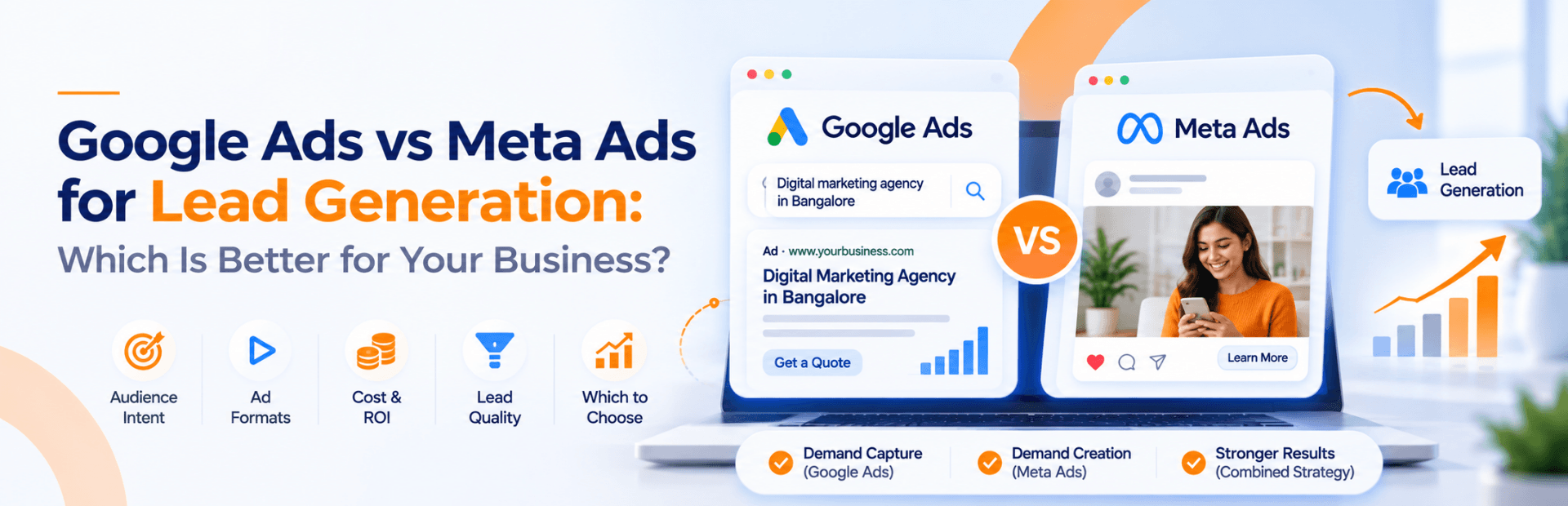
Google Ads vs Meta Ads for Lead Generation: Which Is Better for Your Business?
Compare Google Ads and Meta Ads to understand audience intent, lead quality, advertising costs, campaign formats, and which platform can help your business generate more qualified enquiries.
Choosing the right advertising platform can make a significant difference to your business's ability to attract potential customers, generate enquiries, and increase revenue. Two of the most widely used platforms for paid advertising are Google Ads and Meta Ads (Facebook and Instagram).
However, one question continues to come up among business owners and marketing teams: Google Ads vs Meta Ads for lead generation — which platform delivers better results?
The answer depends on what you sell, who your target customers are, how they discover products or services, and how quickly they make purchasing decisions.
Google Ads allows businesses to reach people who are actively searching for products or services. Meta Ads helps businesses reach potential customers through interest-based discovery, engaging creatives, video advertisements, lead forms, and messaging experiences.
Both platforms can generate leads, but they work differently. Understanding these differences can help you allocate your advertising budget more effectively and build a strategy around qualified enquiries rather than simply increasing the number of leads.
In this guide, we compare Google Ads vs Meta Ads for lead generation, covering audience intent, campaign formats, cost considerations, lead quality, B2B and B2C applications, retargeting, conversion tracking, and how to decide which platform is right for your business.
Quick Answer: Google Ads vs Meta Ads for Lead Generation
Google Ads is particularly useful for reaching people who are already searching for a product, service, or solution. Meta Ads is particularly useful for introducing your business to potential customers who may be interested but are not actively searching.
Neither platform is universally better. The right choice depends on your industry, customer behaviour, marketing objectives, and ability to convert enquiries into customers.
| Comparison Factor | Google Ads | Meta Ads |
|---|---|---|
| Primary opportunity | Capture existing demand | Generate and develop demand |
| Audience discovery | Search queries, contextual signals and audience data | Interests, behaviours, engagement and platform signals |
| Main platforms | Google Search, YouTube, Display, Shopping and Performance Max | Facebook, Instagram, Messenger and WhatsApp destinations |
| Advertising formats | Text, image, shopping, display and video | Image, carousel, video, Stories, Reels and lead ads |
| Lead generation methods | Website forms, calls and eligible lead form assets | Instant forms, website forms, messages and calls |
| Creative requirements | Search-focused ad copy, landing pages and assets | Strong visual content, videos, offers and messaging |
| Typical customer journey | Search, evaluate, enquire and purchase | Discover, engage, evaluate, enquire and purchase |
| Useful measurement | Qualified leads, conversions and acquisition cost | Qualified leads, conversions and acquisition cost |
| Suitable objectives | Demand capture and high-intent enquiries | Discovery, demand creation, nurturing and remarketing |
Understanding How Google Ads Works for Lead Generation
Google Ads allows businesses to display advertisements across Google's advertising network. For lead generation, Search campaigns are especially valuable because they can target people actively searching for specific products, services, and solutions.
For example, imagine someone searching for:
- Digital marketing agency in Bangalore
- Website development company in Bangalore
- Best interior designers near me
- Commercial construction company in Bangalore
- Cloud consulting services for enterprises
These searches indicate that the user is actively exploring a particular product or service. A relevant Google Search advertisement can place your business in front of that potential customer at the moment they are looking for a solution.
How Google Ads Generates Leads
A typical Google Ads lead-generation campaign follows this process:
- A potential customer searches for a relevant keyword.
- Google displays eligible advertisements based on the auction and campaign settings.
- The user clicks an advertisement or interacts with an eligible lead form.
- The user visits your website, calls your business, or submits their information.
- Your sales team follows up and qualifies the enquiry.
- Campaign performance is evaluated using conversion and lead-quality data.
Google Ads Campaign Types for Lead Generation
Google Search Ads
Search campaigns are particularly useful when customers already know what they need. You can target relevant keyword themes and create advertisements aligned with the user's search intent.
For example, a business offering SEO services can target searches related to SEO agencies, SEO consulting, and SEO services in its chosen location.
Performance Max
Performance Max uses Google's advertising inventory across multiple channels through a single campaign, including Search, YouTube, Display, Discover, Gmail and Maps placements where eligible.
It can support lead-generation objectives by using conversion data and creative assets to reach potential customers across Google's inventory.
YouTube Ads
YouTube advertising can introduce a business to potential customers through video content. It is useful for product demonstrations, service explanations, customer education, and building awareness before someone is ready to enquire.
Display Ads and Remarketing
Display advertising can help businesses reach relevant audiences across websites and apps. Remarketing can reconnect with eligible people who have previously visited your website or interacted with your business.
Google Lead Form Assets
Google also supports lead form assets in eligible Search and Performance Max campaigns, allowing users to submit their contact details directly through an advertisement without necessarily visiting the website.
See Google's official documentation on lead form assets in Google Ads.
Advantages of Google Ads for Lead Generation
- Reaches people actively searching for relevant services.
- Supports location-based and keyword-based campaign targeting.
- Provides opportunities to capture high-intent enquiries.
- Offers multiple campaign formats for different customer journeys.
- Supports measurable website conversions, calls, and eligible lead forms.
- Allows businesses to test different keywords, advertisements and landing pages.
Limitations of Google Ads
Google Ads also has limitations that businesses should consider.
Highly competitive keywords can become expensive. Search demand may be limited in niche industries, making it difficult to scale enquiries through Search alone.
Campaign performance also depends on keyword selection, search intent, landing-page quality, conversion tracking, and the competition in the advertising auction.
A business should not assume that a larger advertising budget automatically produces more qualified customers.
Understanding How Meta Ads Works for Lead Generation
Meta Ads allows businesses to advertise across Facebook and Instagram, with additional messaging destinations and placements depending on campaign configuration.
Unlike Google Search, Meta advertising does not primarily depend on a user entering a product or service query. Instead, advertisements can reach audiences based on platform signals, interests, behaviours, engagement, and campaign optimization.
This makes Meta particularly useful for businesses that need to introduce an offering, demonstrate a product, build awareness, or encourage people to explore a service.
For example, a real estate developer promoting a new residential project can use Instagram Reels, Facebook video advertisements, carousel creatives, and lead forms to introduce the property to potential buyers.
Similarly, an education company can advertise courses, communicate admission information, and collect enquiries through lead-generation campaigns.
How Meta Ads Generates Leads
A typical Meta lead-generation campaign follows this process:
- A business identifies its target audience and campaign objective.
- Advertisements are created for Facebook and Instagram placements.
- Meta delivers ads to eligible audiences based on the campaign objective and available signals.
- Interested users interact with an advertisement.
- They submit an instant form, visit a website, call the business, or start a messaging conversation.
- The sales team follows up, qualifies the enquiry, and records the outcome.
Meta Ads Formats for Lead Generation
Facebook Lead Ads
Facebook Lead Ads can collect customer information through forms that appear within the platform. Depending on the configuration, businesses can ask users for contact information and additional qualifying details.
Instagram Ads
Instagram is particularly useful for businesses with visual products, services, projects, and customer experiences.
Businesses can use Reels, Stories, feed advertisements, carousels, and other eligible formats to introduce their offerings and generate enquiries.
Meta Instant Forms
Instant forms allow people to share information directly within Facebook or Instagram. They can reduce the steps involved in submitting an enquiry.
Businesses should configure questions carefully to avoid attracting large numbers of enquiries that are not relevant to their offering.
Click-to-WhatsApp Ads
Businesses can run advertisements that open a WhatsApp conversation, allowing potential customers to ask questions and interact directly with the business.
This can be useful for businesses where customers prefer discussing product details, requesting quotations, checking availability, or speaking with a sales representative.
Learn more about ads that click to WhatsApp.
Meta Remarketing
Meta can also help reconnect with people who have previously engaged with your advertisements, website, or business, subject to audience eligibility and privacy requirements.
For example, an e-commerce business can show relevant product advertisements to eligible website visitors who have not completed a purchase.
Advantages of Meta Ads for Lead Generation
- Helps businesses reach new audiences beyond existing search demand.
- Supports visual storytelling through images, videos, Reels and carousel advertisements.
- Offers instant forms for collecting enquiries within the platform.
- Supports messaging-based lead generation, including WhatsApp.
- Allows businesses to retarget eligible website visitors and engaged audiences.
- Provides opportunities to test creative concepts, offers and audience strategies.
Limitations of Meta Ads
Meta Ads also presents challenges.
People browsing Facebook or Instagram may not be actively looking for your product or service. Some users may submit an enquiry because the form is convenient without having a strong intention to purchase.
The quality of your advertisements, offer, audience signals, form questions and follow-up process can all influence performance.
Meta campaigns also require a consistent supply of suitable creative material. Businesses that use the same advertisement for too long may need to introduce new concepts, visuals, messages and formats.
For this reason, successful Meta advertising requires both campaign optimization and a planned creative strategy.
Google Ads vs Meta Ads: The Major Differences Explained
Now that we understand how both platforms work, let's compare them across the factors that directly influence lead generation.
Search Intent vs Audience Discovery
This is the most important difference between the two platforms.
With Google Search Ads, the user generally initiates the journey by searching for something. Their query provides an indication of what they are looking for.
For example:
- Someone searching for "commercial architects in Bangalore" is likely exploring commercial architecture services.
- Someone searching for "best CRM software for real estate companies" may be comparing software options.
These queries provide contextual information that advertisers can use to match advertisements with the user's needs.
Meta advertising works differently.
A person browsing Instagram may not be looking for an interior designer, financial consultant, or software provider at that moment. However, an advertisement with an attractive offer, relevant content, and clear value proposition can generate interest.
Audience Targeting
Google Ads provides several ways to reach potential customers through search keywords, geographic targeting, audience signals and relevant campaign settings.
Advertisers can target customers searching for specific services and use other campaign types to reach audiences across Google's advertising inventory.
Meta Ads provides audience discovery through platform signals, interests, behaviours, engagement, custom audiences and lookalike audiences where eligible.
For example:
- A fitness business may use Meta to reach audiences interested in fitness-related products and content.
- A B2B technology company may use Google Search to reach users searching for enterprise software solutions and use Meta to support awareness and remarketing.
The right targeting approach depends on the available customer data, campaign objective, platform policies and market demand.
Creative and Content Requirements
Google Search campaigns often depend heavily on relevant keywords, compelling headlines, descriptions, ad assets, and well-designed landing pages.
Meta campaigns generally place greater emphasis on creative content.
Businesses may need:
- High-quality images and graphics.
- Short-form videos and Reels.
- Carousel advertisements.
- Customer testimonials and demonstration videos.
- Clear offers and promotional messages.
- Multiple creative variations for testing.
This is one reason businesses investing in Meta Ads should plan creative production alongside media spending.
For brands that need regular marketing content, professional video production services in Bangalore can support their advertising creative requirements.
Lead Generation Methods
Google and Meta offer several different ways to collect enquiries.
| Lead Generation Method | Google Ads | Meta Ads |
|---|---|---|
| Website enquiry forms | Yes | Yes |
| Phone calls | Yes, through eligible campaign formats | Yes, through eligible formats |
| Native lead forms | Yes, through eligible lead form assets | Yes, through Instant Forms |
| WhatsApp conversations | Through suitable website or messaging journeys, where configured | Click-to-WhatsApp advertisements |
| Landing page campaigns | Yes | Yes |
| Remarketing | Yes | Yes |
The best method depends on how customers prefer to communicate and how your business processes incoming enquiries.
Lead Quality
Lead quality is not determined by the platform alone.
Google Search may generate enquiries from people who are already researching a product or service. Meta may generate enquiries from people who discovered your business through an advertisement.
However, a person searching for a service may only be comparing prices, while someone responding to a Meta advertisement may be ready to purchase.
The campaign must therefore be judged by what happens after an enquiry is generated.
Important quality indicators include:
- Relevant customer requirements.
- Correct contact details.
- Budget suitability.
- Geographic relevance.
- Purchase timeline.
- Sales-qualified enquiries.
- Appointments and meetings.
- Actual customers acquired.
Google Ads vs Meta Ads: Which Is Better for Different Industries?
The right advertising platform changes according to customer behaviour and the type of product or service being promoted.
Here is a practical comparison for common business categories.
| Business Category | Google Ads Opportunity | Meta Ads Opportunity | Strategic Approach |
|---|---|---|---|
| B2B services | Capture businesses searching for specific solutions | Awareness, educational content and remarketing | Both, based on demand |
| Real estate | Capture property-related searches | Project discovery, videos and enquiry generation | Both |
| Education | Reach users searching for courses and admissions | Promote courses, offers and admission campaigns | Both |
| Healthcare | Reach relevant local service searches | Awareness and eligible service campaigns | Depends on service and advertising policies |
| E-commerce | Shopping and product-intent searches | Product discovery and catalogue advertising | Both |
| Interior design | Capture people looking for designers | Showcase completed projects and visual inspiration | Both |
| Manufacturing | Reach procurement and product-related search queries | Build awareness among relevant business audiences | Search-led with supporting Meta campaigns |
| Restaurants | Capture local dining and ordering searches | Promote offers, menus, events and location-based awareness | Both |
| Professional consulting | Target specific service and problem-related searches | Retargeting and authority-building content | Search-led with supporting Meta |
| Fitness and wellness | Capture people searching for nearby services | Promote programs, experiences and offers | Both |
These are strategic starting points, not fixed platform rankings. Campaigns should be evaluated using the actual lead quality and economics of each business.
Which Platform Is Better for B2B Lead Generation?
For many B2B service companies, Google Search is a useful starting point because potential buyers often search for specific business solutions.
For example, a company looking for software development services may search for:
- Custom software development company.
- Enterprise software development services.
- Software development company in Bangalore.
- Business automation solutions.
Google Ads can help businesses reach these potential buyers when they are actively researching solutions.
Meta can complement this activity by distributing case studies, educational videos, industry insights, and business-focused advertisements to eligible audiences.
Recommended approach: Use Google Search to capture relevant service demand and Meta to build awareness, nurture interest and reconnect with eligible audiences.
Which Platform Is Better for Local Businesses?
Google Search is useful when customers search for nearby providers, professional services, repairs, appointments, and other location-specific requirements.
For example, a customer searching for a dental clinic in Bangalore may already have a specific requirement.
Meta can support local businesses through offers, promotions, visual content, customer stories and WhatsApp enquiries.
Recommended approach: Combine local search demand capture with Meta campaigns that encourage discovery and repeat engagement.
Which Platform Is Better for E-commerce Businesses?
E-commerce businesses can benefit from both advertising platforms.
Google Shopping and Performance Max can connect products with users searching for relevant merchandise.
Meta can showcase products through images, videos, catalogues and retargeting campaigns.
For example, a fashion business may use Google to capture demand for specific product categories while using Instagram to demonstrate collections, introduce new arrivals, and encourage product discovery.
Recommended approach: Use both platforms when the business has sufficient product data, conversion tracking, creative assets and budget to support meaningful optimization.
Which Platform Has a Lower Cost Per Lead: Google Ads or Meta Ads?
Cost per lead (CPL) is one of the most common metrics businesses use when comparing advertising campaigns.
However, a lower CPL does not necessarily mean better business performance.
Meta campaigns may generate a greater volume of form submissions in some situations, while Google Search campaigns may generate fewer enquiries with stronger purchase intent in others.
The outcome varies according to industry competition, target audience, advertising creative, keyword demand, offer and campaign optimization.
Understanding Cost Per Lead
The basic CPL formula is:
For example, if a business spends ₹30,000 on an advertising campaign and receives 60 enquiries:
CPL = ₹30,000 ÷ 60 = ₹500.
However, it is also important to measure cost per qualified lead.
Why Qualified CPL Matters More Than Total CPL
Consider the following hypothetical example:
| Metric | Google Ads | Meta Ads |
|---|---|---|
| Advertising spend | ₹30,000 | ₹30,000 |
| Leads generated | 30 | 100 |
| Cost per lead | ₹1,000 | ₹300 |
| Qualified leads | 15 | 10 |
| Cost per qualified lead | ₹2,000 | ₹3,000 |
| Customers acquired | 3 | 2 |
| Customer acquisition cost | ₹10,000 | ₹15,000 |
In this hypothetical scenario, Meta generates more enquiries at a lower CPL. However, Google generates more qualified leads and customers.
This demonstrates why evaluating advertisements only by the cheapest lead can result in poor budget decisions.
For a business, the more meaningful questions are:
- How many enquiries match the target customer profile?
- How many leads are contacted successfully?
- How many enquiries become sales opportunities?
- How many customers are actually acquired?
- What is the cost of acquiring each customer?
- Does the revenue justify the advertising investment?
Your optimization strategy should prioritize business value, not just the cost of collecting contact information.
How Much Budget Should You Allocate to Google Ads and Meta Ads?
Your advertising budget should be determined by business objectives, customer acquisition economics and the amount of demand available on each platform.
There is no universal Google-to-Meta budget ratio that works for every business.
A company generating enquiries for high-value B2B services may allocate more of its initial test budget to Google Search because customers actively research those services.
A new e-commerce brand may need more Meta creative testing and broader audience discovery while also capturing existing product searches through Google.
A Practical Approach to Budget Allocation
Identify Your Primary Objective
Determine whether your goal is immediate enquiries, product sales, appointments, registrations, brand awareness or demand creation.
Understand Your Customer Journey
Find out whether your potential customers actively search for your product or need to discover it through advertisements and content.
Evaluate Existing Demand
Use keyword research and Google Keyword Planner to understand available search demand, competition and potential advertising costs.
Review your customer data and historical campaign performance before deciding how much to allocate to Meta.
Run Controlled Campaigns
Start with clearly defined campaign objectives, separate budgets, suitable landing pages and accurate conversion tracking.
Reallocate Based on Qualified Results
After enough relevant data has accumulated, adjust budgets according to qualified leads, sales opportunities, customer acquisition cost and revenue.
The purpose is to identify which channel produces the most valuable business outcomes, rather than simply increasing advertising spend.
How to Improve Lead Quality on Google Ads and Meta Ads
Generating leads is only the beginning. Businesses must also ensure that incoming enquiries are relevant and that their sales teams can convert them effectively.
The following practices can improve lead generation performance on both platforms.
Target the Right Audience
For Google Ads, use relevant keyword themes, location settings and campaign structures. Identify irrelevant search intent and review search-term data regularly.
For Meta Ads, define the campaign objective, creative approach and eligible audience signals around your actual customer profile.
Avoid trying to reach everyone. Focus on customers who are most likely to need your offering.
Use Dedicated Landing Pages
A relevant landing page helps users understand what your business offers and why they should enquire.
A good landing page should include:
- A clear headline explaining the service or product.
- Benefits relevant to the target audience.
- Information about your business and capabilities.
- Relevant proof, credentials or customer feedback.
- A prominent enquiry form or contact option.
- Mobile-friendly design and fast loading.
- A clear next step.
Sending all advertising traffic to a generic homepage may create unnecessary friction.
Businesses needing conversion-focused website improvements can explore website development services in Bangalore.
Create Compelling Advertisements
Your advertisement should communicate the problem you solve and why someone should consider your business.
For Google Search, focus on relevant search terms, clear service descriptions and useful differentiators.
For Meta, test different images, videos, hooks, customer benefits, testimonials and calls to action.
Creative testing is particularly important when targeting audiences who are discovering your business for the first time.
Use Lead Qualification Forms
Asking a few relevant questions can help businesses understand whether an enquiry matches their requirements.
For example, a B2B software company may ask:
- What type of software do you need?
- What is your company size?
- What is your expected project timeline?
- What is your approximate project budget?
A real estate business may ask about preferred location, property type and purchase timeline.
The questions should be appropriate to your offering without making the form unnecessarily complicated.
Respond to Enquiries Quickly
Delayed follow-up can reduce the likelihood of converting an interested prospect into a customer.
Establish a process for assigning enquiries, making initial contact, qualifying requirements, scheduling meetings and recording outcomes.
For businesses generating enquiries through Meta Instant Forms, CRM integration can help connect marketing activity with sales follow-up. Meta's Conversions API for CRM training explains how CRM information can support optimization toward lead quality rather than volume.
Continuously Optimize Your Campaigns
Regularly review:
- Search terms and keyword performance.
- Audience and placement performance.
- Advertisement engagement and conversion rates.
- Landing page behaviour.
- Enquiry quality.
- Cost per qualified lead.
- Customer acquisition cost.
Pause underperforming activities, investigate the reasons for weak performance and test improvements systematically.
Conversion Tracking: The Most Important Part of Paid Advertising
One of the most common mistakes businesses make is running advertising campaigns without proper conversion measurement.
Clicks, impressions and form submissions provide useful information, but they do not tell you the full business impact of an advertising campaign.
A proper tracking setup should connect the user's journey from the first advertisement interaction to the final sales outcome.
Google Ads Conversion Tracking
Google Ads campaigns can be measured through conversion actions such as:
- Website enquiry submissions.
- Phone calls.
- Appointment bookings.
- Quotation requests.
- Purchases.
- Qualified leads and converted leads.
For more advanced lead-generation campaigns, enhanced conversions for leads can help connect online interactions with offline sales outcomes.
Google recommends using relevant lead conversion goals and better measurement signals to help optimize toward valuable outcomes rather than simply increasing form submissions.
Refer to Google's Performance Max lead-quality guidance.
Meta Ads Conversion Tracking
Meta campaigns can use the Meta Pixel and Conversions API, depending on the implementation and campaign setup.
Businesses should consider measuring:
- Website visits and important page interactions.
- Enquiry form submissions.
- Phone or messaging enquiries.
- Qualified leads.
- Sales opportunities.
- Purchases and revenue.
When appropriate, CRM integration can provide information about which leads progressed through the sales pipeline.
This gives advertising platforms more meaningful information than basic form-submission counts.
Essential Marketing Measurement Tools
For a properly measured lead-generation strategy, consider:
| Tool | Primary Purpose |
|---|---|
| Google Analytics 4 | Website traffic and conversion analysis |
| Google Tag Manager | Managing tracking tags and events |
| Google Ads Conversion Tracking | Measuring advertising conversions |
| Meta Pixel | Measuring relevant website events |
| Meta Conversions API | Server-side event sharing |
| CRM software | Managing enquiries and tracking sales progress |
| Looker Studio | Building performance dashboards |
The objective is to understand which campaigns generate customers, not just which campaigns generate clicks.
Should Businesses Run Google Ads and Meta Ads Together?
For many businesses, using both platforms can create a more complete lead-generation strategy.
Google Ads and Meta Ads can support different stages of the customer journey.
A potential customer may first discover your business through an Instagram advertisement, explore your website, and later search for your company or service on Google.
Another customer may discover your business through a Google Search advertisement, visit your website, and later see a Meta remarketing advertisement.
Both advertising platforms can therefore contribute to the same conversion journey.
Example: A Combined Advertising Strategy for a B2B Service Company
Imagine a Bangalore-based company offering enterprise software development services.
A potential strategy could look like this:
Google Search Campaigns
Target users searching for enterprise software development, custom software solutions and related services.
Meta Awareness Campaigns
Promote educational content, industry insights, project demonstrations and business-focused videos to relevant audiences.
Remarketing Campaigns
Reconnect with eligible website visitors and people who have interacted with relevant advertisements.
Lead Capture
Use dedicated landing pages, enquiry forms and appropriate messaging options to collect business enquiries.
Lead Qualification
Record incoming leads, assess their project requirements, and classify them as qualified or unqualified.
Measurement and Optimization
Compare channel performance using qualified leads, sales meetings, opportunities, customer acquisition cost and revenue.
This approach allows businesses to capture existing demand while developing additional interest among potential buyers.
For a broader look at paid acquisition and AI-assisted campaign management, read our guide on how AI is changing Google and Meta Ads management in 2026.
Google Ads vs Meta Ads: Which Platform Should Your Business Choose?
Before making a decision, consider the following framework.
Choose Google Ads as a Starting Point When:
- Customers actively search for the products or services you provide.
- Your business offers a solution to a clearly defined problem.
- Search demand exists for your target keywords.
- You want to capture customers who are researching or comparing providers.
- Your business depends on high-intent local or service-related enquiries.
Choose Meta Ads as a Starting Point When:
- Your product or service needs visual demonstration.
- You want to introduce your business to new audiences.
- Your offering has a strong lifestyle, visual or promotional appeal.
- You can produce engaging advertising creatives.
- You want to generate enquiries through instant forms or messaging.
- You want to reconnect with eligible audiences who have previously engaged with your brand.
Consider Both Platforms When:
- You have sufficient budget for meaningful testing.
- You want to capture existing demand and create new demand.
- You need a broader customer acquisition strategy.
- Your website and sales process can handle enquiries from multiple channels.
- You have accurate conversion tracking and a process for evaluating lead quality.
How Trivia Digital Agency Can Help with Google Ads and Meta Ads
Choosing an advertising platform is only one part of building a successful paid acquisition strategy. Your campaign structure, targeting, creative quality, landing pages, conversion tracking and ongoing optimization all influence the final outcome.
At Trivia Digital Agency, we work with businesses to develop performance-focused digital advertising strategies based on their marketing objectives and customer acquisition requirements.
Our performance marketing capabilities include:
- Google Ads Management: Search campaigns, keyword research, campaign setup, bidding strategies and ongoing optimization.
- Meta Ads Management: Facebook and Instagram campaigns, audience research, creative testing and lead-generation campaigns.
- PPC Advertising: Paid campaign planning, targeting, ad copy and performance measurement.
- Remarketing and Retargeting: Reconnecting with eligible audiences who have already interacted with your business.
- Lead Generation: Building campaigns around enquiries, appointments, qualified opportunities and customer acquisition.
- Conversion Tracking: Measuring campaign performance and understanding the value generated from paid advertising.
Our approach brings Google Ads, Meta Ads, creative strategy, tracking and conversion optimization together to support measurable business growth.
Explore our performance marketing services in Bangalore to understand how we can help plan and manage paid advertising campaigns.
You can also explore our broader digital marketing services in Bangalore for an integrated approach to online visibility and customer acquisition.
Frequently Asked Questions
Which is better for lead generation: Google Ads or Meta Ads?
Google Ads is particularly useful for capturing people actively searching for a product or service. Meta Ads is useful for creating demand, reaching new audiences and generating enquiries through visual advertisements, instant forms and messaging. The right platform depends on your industry, customer intent, budget and lead-quality requirements.
Are Google Ads more expensive than Meta Ads?
Not necessarily. Advertising costs depend on the industry, audience, competition, campaign objective and advertisement quality. Google Search can involve competitive keyword auctions, while Meta costs are influenced by audience demand, creative performance and campaign optimization. Compare cost per qualified lead and customer acquisition cost rather than CPC alone.
Which is better for B2B lead generation: Google Ads or Facebook Ads?
Google Search can be effective for B2B companies targeting people actively researching specific services or solutions. Facebook and Instagram can complement B2B acquisition through awareness campaigns, educational content and remarketing. A combined approach may be appropriate when sufficient budget and tracking are available.
Which platform is better for small businesses?
Small businesses should first identify whether customers actively search for their offering. If relevant search demand exists, Google Ads may be a useful starting point. If the product depends on visual discovery, promotions or audience engagement, Meta may be a suitable option. Start with a focused strategy rather than spreading a limited budget across too many campaigns.
Can I run Google Ads and Meta Ads simultaneously?
Yes. Businesses can run both platforms together to capture existing search demand and generate new audience interest. However, each platform should have a clearly defined role, appropriate budgets, accurate conversion tracking and measurable objectives.
Are Meta Lead Ads better than website landing pages?
Meta Instant Forms can make it easier for people to submit information within Facebook or Instagram. Website landing pages offer more control over messaging, qualification, analytics and the overall customer experience. The better option depends on the service, form complexity, lead quality and follow-up process. Both approaches can be tested where suitable.
How do I improve lead quality from Google Ads?
Use relevant keywords, appropriate geographic targeting, conversion-focused landing pages and clear service information. Exclude irrelevant search terms, qualify enquiries through suitable forms and track the progression of leads into sales opportunities.
How do I improve lead quality from Meta Ads?
Use relevant creatives, clear offers, suitable audience signals and appropriate lead forms. Consider qualification questions, timely sales follow-up and CRM integration. Where technically and commercially appropriate, send qualified lead outcomes back through the supported measurement integrations.
How long does it take for Google Ads and Meta Ads to generate leads?
Both platforms can generate enquiries after campaigns become eligible and start serving. However, the time needed to achieve consistent and commercially useful results varies according to campaign setup, budget, competition, creative quality, conversion tracking and sales follow-up. Early leads should be treated as learning data rather than a guarantee of sustained performance.
Should I hire a Google Ads or Meta Ads agency in Bangalore?
Choose an agency based on its ability to understand your business, select appropriate channels, set up campaigns, measure conversions and optimize toward qualified leads. A performance marketing agency that can manage both Google and Meta may be useful when your business needs an integrated advertising strategy.
Related Digital Marketing Insights
Explore more insights from Trivia Digital Agency to strengthen your digital marketing and customer acquisition strategy.
Generate More Qualified Leads with Google Ads and Meta Ads
Google Ads and Meta Ads can both contribute to business growth when they are supported by the right strategy, audience targeting, creative content and conversion measurement.
At Trivia Digital Agency, we help businesses plan and manage paid advertising campaigns designed around their marketing objectives and customer acquisition requirements.
Whether you want to capture high-intent search traffic, generate new audience interest, improve lead quality or build an integrated paid advertising strategy, our team can help you evaluate the right approach.
Looking for a performance marketing agency in Bangalore? Connect with Trivia Digital Agency to discuss your business goals and advertising opportunities.
Request a Paid Campaign Assessment