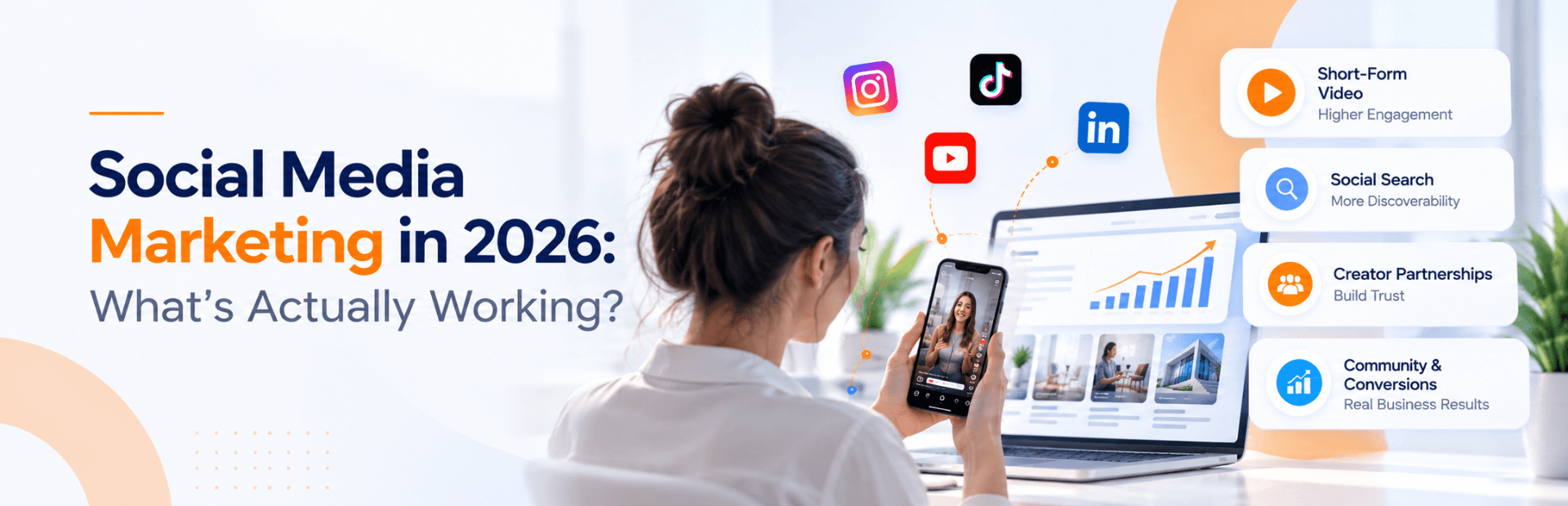
Social Media Marketing in 2026: What's Actually Working?
A practical guide to the social media strategies, discovery behaviours, content formats, creator models, AI workflows and measurement approaches shaping 2026.
Social media marketing in 2026 is no longer about posting every day, chasing every trending audio or collecting followers for the sake of a bigger number.
The strategies working now are much more focused. For businesses building a broader digital marketing strategy, social media increasingly works alongside search, paid media, content and conversion activity.
Brands are using short-form video, social search optimisation, original human-led content, creator partnerships, community building, artificial intelligence and smarter paid amplification to turn social media into a measurable business channel.
The biggest change is simple: social platforms are becoming discovery engines, not just places where people follow accounts they already know.
People increasingly use Instagram, TikTok, YouTube, LinkedIn and other platforms to discover brands, research products, compare options, learn something new and decide what to buy.
So, what is actually working in social media marketing in 2026? If you are planning a social media marketing strategy, the following areas are worth prioritising.
What Is Working in Social Media Marketing in 2026?
The strongest social media marketing strategies in 2026 combine compelling short-form video with original expertise, search-friendly content, trusted human voices and clear conversion paths.
Instead of trying to reach everyone, successful brands are focusing on the right audience, the right platform and content that solves a specific problem.
HubSpot's 2026 marketing research found that around 60% of marketers use short-form video, while nearly 49% identify it as their highest-ROI content format.
But video alone is not the strategy.
The brands getting results are building an entire system around discovery, trust, engagement and conversion.
1. Short-Form Video Is Still Leading
Reels, TikToks, YouTube Shorts and short LinkedIn videos continue to dominate social media content strategies.
But there has been an important shift.
The goal is no longer simply to make a video short.
It needs to make someone stop.
A strong 2026 short-form video normally communicates its subject immediately, gives the viewer a reason to continue watching and delivers one clear idea rather than trying to explain everything at once.
Educational videos, demonstrations, comparisons, quick answers, customer stories, behind-the-scenes footage, founder-led videos and relatable observations are particularly well suited to the format. Strong video production and creative execution can help turn these ideas into reusable social assets.
HubSpot's 2026 research ranks short-form video ahead of long-form video, live streaming, user-generated content and blog posts for perceived ROI among surveyed marketers.
For businesses, the lesson is straightforward:
Create videos around questions your customers already ask rather than creating videos simply because Reels are popular.
A 30-second video answering a real buying question can generate more meaningful results than an expensive brand film with no clear purpose.
2. Social SEO Is Becoming Essential
Social media and search are increasingly overlapping.
Consumers do not always begin their research journey on a traditional search engine. They may search Instagram for a restaurant, TikTok for product reviews, YouTube for tutorials or LinkedIn for professional advice.
That means social media SEO should now be part of your content strategy. It also connects with the wider shift toward SEO, GEO and AEO as businesses optimise for multiple discovery environments.
Social SEO means making your profiles and content easier to understand and discover when users search for relevant subjects.
If you are creating content about digital marketing, for example, clearly saying and writing phrases such as "social media marketing strategy", "Instagram marketing", "B2B social media" or "short-form video marketing" gives both users and platforms better context than vague captions.
Optimise your profile name, bio, captions, video titles, on-screen copy and spoken content around topics your audience genuinely searches for. For a broader view of this shift, see our guide to AI Search Optimization.
Do not turn every caption into a block of keywords.
The objective is relevance, not keyword stuffing.
Social search has become significant enough that recent 2026 industry research now treats it as a major product- and brand-discovery behaviour rather than a secondary social feature.
3. Original Content Matters More Than Content Volume
AI has made content creation dramatically faster.
That also means audiences are seeing more generic content than ever.
Producing ten average posts every day is not automatically better than publishing three genuinely useful pieces of content each week.
Platforms themselves are increasingly emphasising originality.
Meta reported in January 2026 that 75% of Instagram recommendations in the US were coming from original posts, following changes designed to increase the presence of original content. Facebook has also clarified that duplicative or minimally edited third-party content can be deprioritised.
For brands, this makes first-hand content more valuable. This aligns with the broader move from traditional search visibility toward AI citations and digital visibility, where clear, original and useful information can strengthen how a brand is understood across discovery systems.
Show the product being used.
Show the founder explaining an opinion.
Show how something is made.
Share actual customer questions.
Publish original research.
Explain lessons from real campaigns.
Show before-and-after results where appropriate.
Content that could have been published by any competitor is becoming easier to ignore.
4. Human-Led Content Is Beating Faceless Corporate Content
A recognisable human voice can often build trust faster than a polished corporate post. This is also consistent with the wider shift toward brand recommendations across ChatGPT, Gemini and Perplexity, where clear expertise and consistent brand information matter.
This is particularly important for service businesses, professional services and B2B brands.
Instead of allowing the company logo to do all the talking, businesses can bring founders, employees, customers, specialists and creators into their social media strategy.
LinkedIn's 2026 marketing guidance strongly emphasises this shift towards people-led thought leadership, creator partnerships and video. The platform argues that trusted individual voices are becoming increasingly important in B2B communication.
This does not mean every founder needs to become an influencer.
It simply means expertise should have a face.
A knowledgeable person answering a real customer question on camera may create more trust than another perfectly designed promotional graphic.
5. AI Works Best as an Assistant, Not the Brand Voice
Artificial intelligence is now embedded throughout social media marketing. The same AI-driven shift is reshaping customer discovery and acquisition across the wider digital marketing landscape in 2026.
Marketers use AI for research, ideation, caption development, scripting, editing, creative variations, reporting, audience analysis and campaign optimisation.
HubSpot's 2026 research shows AI adoption is already widespread across marketing workflows.
The opportunity is enormous, but so is the risk of sameness.
If every brand asks an AI tool to "write an engaging Instagram caption", feeds quickly fill with similar hooks, sentence structures and ideas.
The smarter approach is to use AI to accelerate execution while keeping strategy, expertise, opinion and final editorial judgement human.
Use AI to generate twenty possible hooks.
Then choose the one that actually sounds like your brand.
Use AI to analyse hundreds of comments.
Then let a human identify why customers care.
Use AI to repurpose a webinar.
But make sure the resulting posts still contain a clear point of view.
In 2026, AI efficiency is useful. Human differentiation is the advantage.
6. Creator Marketing Is Moving Beyond Celebrity Influencers
Influencer marketing is becoming more specialised.
A creator does not need millions of followers to influence buying decisions.
For many businesses, smaller creators with a defined audience and genuine subject expertise can be more relevant than broad celebrity reach.
The shift is also happening in B2B.
LinkedIn's current 2026 marketing research highlights growing investment in B2B creators and people-led thought leadership, while creator-marketing research from Northwestern University's Spiegel Research Center found that many surveyed brands now operate creator programmes on an ongoing rather than purely campaign-by-campaign basis.
A strong creator partnership should therefore begin with audience relevance, credibility and creative fit rather than follower count.
The question should not be:
"Who has the biggest audience?"
It should be:
"Whose audience already trusts them on the subject we want to talk about?"
7. Community Is Becoming More Valuable Than Passive Followers
A large follower count does not automatically mean a strong brand.
A smaller audience that comments, shares, asks questions, recommends the company and returns regularly can have much greater commercial value.
That is why community management has become a core part of modern social media marketing.
Responding to comments, continuing conversations in direct messages, participating in relevant communities and creating content from audience questions can turn social media from a publishing channel into a relationship channel.
Community also creates something AI-generated content cannot easily manufacture: genuine interaction between people who care about a shared subject.
The strongest brands do not only publish.
They participate.
8. Organic and Paid Social Work Better Together
The old separation between organic social media and paid social media is becoming less useful.
Organic content can act as a testing ground.
If a video naturally produces strong watch time, comments, saves, profile visits or leads, it may be an excellent candidate for paid amplification.
Instead of guessing which advertising creative will work, brands can use organic performance to identify stronger messages first.
Paid campaigns can then extend proven creative to new audiences, retarget engaged visitors or drive users towards a specific commercial action.
This creates a more efficient loop:
Organic content discovers what resonates. Paid media scales it. Performance data improves the next round of organic content. This is where a dedicated performance marketing strategy can connect social creative with measurable acquisition and conversion goals.
Meta continues to invest heavily in AI-based advertising, creative optimisation and recommendation systems, reinforcing the importance of providing ad platforms with strong creative and reliable conversion data rather than relying entirely on manual audience micromanagement.
9. Social Commerce Is Reducing the Gap Between Discovery and Purchase
The journey from seeing a product to purchasing it continues to get shorter. Businesses should therefore think beyond social reach and consider the website experience, landing pages and conversion journey together; our guide to conversion-focused web design trends for 2026 covers this broader connection.
People can discover a product through a Reel, watch a creator demonstrate it, read comments from customers and move towards purchasing without following the traditional website-first journey.
That is why social commerce matters.
HubSpot's 2026 research found a significant proportion of marketers expect more shopping activity to happen directly within social platforms, while TikTok continues to develop advertising and discovery products that connect content discovery with purchase intent.
For e-commerce businesses, content and conversion should therefore be planned together.
Do not create a viral product video and only afterwards ask where interested customers should go.
The conversion journey should already be built.
10. Being Everywhere Is Not a Social Media Strategy
One of the biggest mistakes businesses make is trying to maintain every social platform.
The result is often a large amount of mediocre content.
A better social media strategy in 2026 is to identify where your ideal customers actually spend time and concentrate resources there. For businesses serving the Bengaluru market, this can be integrated with a wider digital marketing strategy in Bangalore .
For a B2B professional services company, that may mean LinkedIn and YouTube.
For a fashion or lifestyle business, Instagram, TikTok and YouTube Shorts may make more sense.
For a local business, Instagram and Facebook may still be valuable.
Platform choice should follow audience behaviour and business objectives—not hype.
What Should You Measure in 2026?
Follower growth and likes can still provide useful context, but they should not be the only measures of success.
The right metrics depend on the objective.
For awareness campaigns, look at qualified reach, video completion, watch time and brand search.
For educational content, saves, shares, returning viewers and profile visits can reveal whether people actually value the content.
For lead-generation campaigns, track enquiries, qualified leads, conversion rate and customer acquisition cost.
For e-commerce, revenue, assisted conversions, repeat purchase behaviour and return on advertising spend become more important. These metrics should be connected to a measurable performance marketing framework rather than social engagement alone.
The best social media metric is the one that connects content activity with the business outcome you are trying to create.
A Practical 90-Day Social Media Strategy for 2026
During the first 30 days, audit the previous three to six months of content. Identify which subjects, formats and creative styles generated genuine engagement or conversions. Research customer questions, search behaviour, competitors and platform-specific opportunities. Then define three to five repeatable content themes.
From days 31 to 60, begin publishing consistently around those themes. Prioritise original short-form video, useful educational content, customer or creator content and search-friendly posts. Test different hooks, formats and calls to action while keeping the underlying subject consistent enough to produce meaningful data.
From days 61 to 90, analyse which topics and creative approaches are producing the strongest business signals. Repurpose successful ideas, build content series around proven subjects and consider paid amplification for your best-performing organic creative.
The objective is not to produce more content every month. It is to build a repeatable system in which content, search visibility, paid distribution and conversion work together.
It is to become better at identifying what deserves to be produced.
What Is No Longer Working?
Generic AI-generated posts, copying viral competitors, posting identical content across every platform, excessive hashtag stuffing, chasing followers without understanding audience quality and publishing purely promotional content are increasingly weak strategies. The same principle applies to zero-click search and AI-driven discovery: visibility increasingly depends on being useful wherever the customer is researching.
Overproduction can also become a problem.
Audiences do not automatically trust something because it looks expensive.
HubSpot's 2026 social research found that 76% of surveyed marketers believe authentic content performs better than highly produced content.
Strong creative still matters.
But polish should support the message rather than replace it.
The Future of Social Media Marketing Is About Relevance
Social media marketing in 2026 is becoming simultaneously more automated and more human.
AI can generate ideas faster.
Algorithms can personalise distribution more accurately.
Advertising platforms can optimise campaigns automatically.
But none of those technologies eliminate the need for a clear idea, genuine expertise and a reason for someone to care.
The brands most likely to build sustainable social media performance are not necessarily those posting the most.
They are the brands producing original, useful and memorable content for a clearly defined audience, distributing it intelligently and measuring what actually contributes to growth.
That is what is working in social media marketing in 2026. Businesses that want to connect social activity with their wider digital presence can also explore SEO services in Bangalore, especially when social discovery, search visibility and content strategy overlap.
Social Media Marketing in 2026: FAQs
What is working in social media marketing in 2026?
Short-form video, social search optimisation, original human-led content, creator partnerships, community building, AI-assisted workflows and smarter paid amplification are highlighted throughout the article.
Is short-form video still important in 2026?
Yes. Reels, TikToks, YouTube Shorts and short LinkedIn videos remain important, but the article stresses clear subjects, strong hooks and one useful idea per video.
Why is social SEO becoming important?
People increasingly use Instagram, TikTok, YouTube and LinkedIn for discovery and research, so profiles, captions, titles, on-screen copy and spoken content should provide clear topical context.
How should brands use AI in social media marketing?
The article recommends using AI to accelerate research, ideation, scripting, editing, analysis and optimisation while keeping strategy, expertise, opinion and final editorial judgement human.
Should a business be active on every social platform?
No. Platform choice should follow audience behaviour and business objectives rather than the pressure to maintain every channel.
What should businesses measure?
Metrics should match the objective, including qualified reach and watch time for awareness, saves and shares for educational content, qualified leads and conversion rate for lead generation, and revenue, assisted conversions and ROAS for e-commerce.
Connect Social Media With Business Growth
Build a focused social media strategy that connects content, discovery, paid distribution and measurable conversion goals.
Talk to Trivia Digital Agency