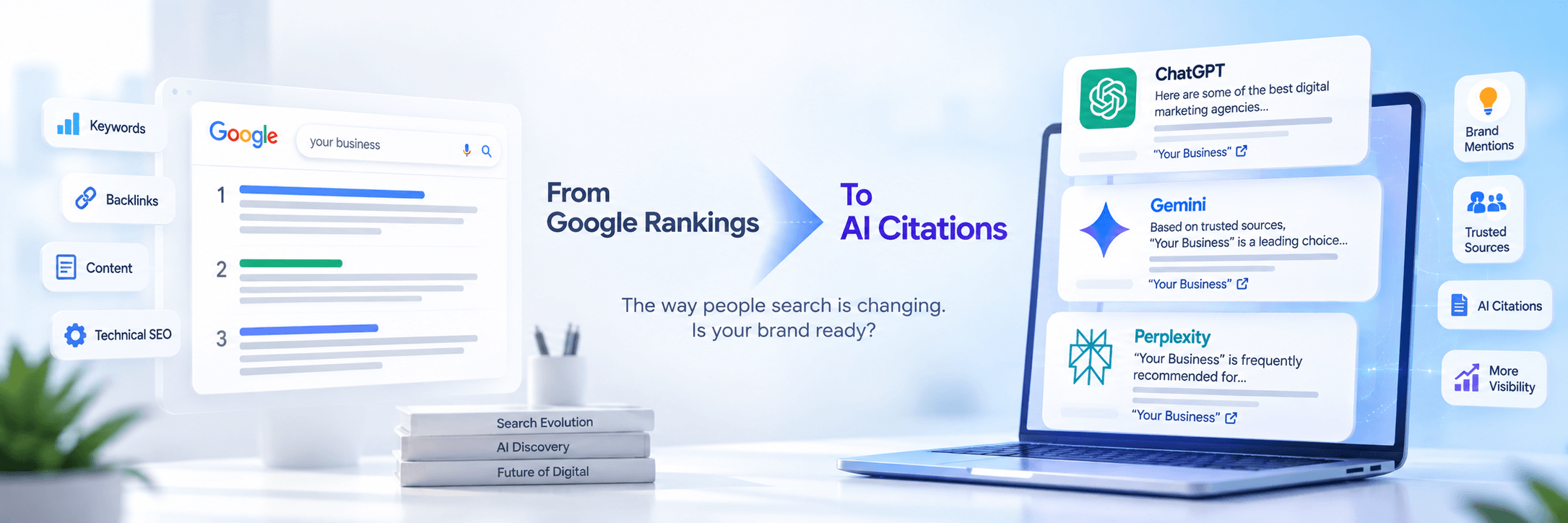
From Google Rankings to AI Citations: How Digital Visibility Is Changing
How digital visibility is evolving from traditional rankings to AI citations, brand authority and search-everywhere discovery in 2026.
For years, digital marketing had a relatively simple measurement model:
A business could open Google Search Console, check keyword rankings, track organic traffic and determine whether its SEO strategy was moving in the right direction.
But search is changing.
They may instead ask:
“What are the best digital marketing agencies for a growing business?”
An AI-powered search experience may research the question, synthesize information from multiple sources, mention several companies and provide citations.
The user may then click one of those citations—or may make a decision based largely on the AI-generated answer.
This creates a new dimension of digital visibility:
But the shift isn't as simple as:
Traditional rankings still matter.
Google's current guidance says SEO best practices remain relevant to AI Overviews and AI Mode because these experiences are built on Google's core Search ranking and quality systems.
The real shift is broader:
Digital visibility is expanding from ranking individual pages to building a brand and information ecosystem that can be discovered, understood, cited and trusted across multiple search environments.
What Is Digital Visibility in 2026?
Digital visibility is the extent to which a brand, website, product, service or expertise can be discovered across the digital channels customers use to research and make decisions.
Traditionally, digital visibility focused heavily on:
- Google rankings
- Organic traffic
- Search impressions
- Backlinks
- Social Media Marketing reach
- Paid advertising
In 2026, the picture is becoming broader.
Digital visibility can include:
- Traditional search rankings
- Google AI Overviews
- Google AI Mode
- ChatGPT Search
- Gemini-powered experiences
- Perplexity citations
- YouTube visibility
- Social discovery
- Review platforms
- Industry publications
- Community discussions
- Brand mentions
- AI-generated recommendations
This means a business can be highly visible even when the customer doesn't necessarily click a traditional blue search result.
What Is an AI Citation?
An AI citation is a reference or link to a source that an AI-powered search or answer system uses to support information in its response.
For example, a user might ask:
“What are the benefits of technical SEO?”
An AI search system may produce an answer and cite several webpages supporting its explanation.
Those citations provide a path for users to verify the information or explore the original source.
Perplexity explicitly describes its search experience as producing cited answers with links to the sources behind its claims.
ChatGPT Search can also provide citations and links to relevant web sources. OpenAI says public websites can appear in ChatGPT Search and that websites should allow OAI-SearchBot to crawl content they want to be eligible for discovery and citation.
Google's AI search experiences similarly surface relevant links that help users explore supporting information.
So citations are becoming an important part of the AI-search ecosystem.
Google Rankings vs AI Citations
The difference can be simplified like this:
| Traditional SearchAI Search | |
|---|---|
| Rank a webpage | Surface useful information |
| Keyword-focused | Intent and context-focused |
| SERP position | Mention/citation/visibility |
| Click-through traffic | Discovery + citation + referral |
| Search result | Synthesized answer |
| Page authority | Source and brand authority |
| Keyword ranking | Topic/entity relevance |
| Backlinks | Broader authority ecosystem |
However, these aren't two completely separate systems.
Google's own guidance says its generative AI features are grounded in core Search systems, including retrieval from its Search index.
That means the future isn't:
It's:
Why Google Rankings Still Matter
It's tempting to say:
“AI search has arrived, so rankings don't matter anymore.”
That's not supported by Google's current guidance.
Google says AI Overviews and AI Mode rely on its core Search systems to retrieve relevant, up-to-date web pages. It also states that existing SEO best practices remain relevant.
For a page to be eligible as a supporting link in Google's AI search experiences, it still needs to meet the normal technical requirements for Google Search and be indexed.
So continue investing in:
- Technical SEO
- Crawlability
- Indexability
- Internal linking
- Search intent
- Helpful content
- Page experience
- Structured data where appropriate
- Relevant backlinks
- Local SEO
- Content architecture
AI search doesn't eliminate these fundamentals.
It makes them part of a larger visibility strategy.
The Search Journey Is Becoming More Complex
Consider a customer looking for a digital marketing agency.
Old journey
Search “digital marketing agency”
Compare websites
Visit website
Contact agency
New journey
Ask a detailed question
AI researches the topic
AI synthesizes information
Several companies or sources are mentioned
User investigates selected brands
User visits websites, reviews and social profiles
User makes a decision
The customer may interact with multiple sources before ever visiting your website.
This means your website is no longer the entire digital marketing asset.
The Information Ecosystem Behind Your Brand
Imagine an AI system trying to understand your company.
It may encounter information from:
- Your website
- About page
- Service pages
- Blog
- Google Business Profile
- YouTube
- Industry directories
- Review platforms
- News publications
- Partner websites
- Interviews
- Podcasts
- Case studies
- Other websites
If all these sources consistently communicate:
your brand becomes easier to understand.
If they contradict each other, the picture becomes less clear.
This is why entity consistency and brand authority matter in AI search.
From Keywords to Entities and Topics
Traditional SEO often starts with:
“What keyword should we target?”
Modern search strategy should also ask:
“What topic should we own?”
And:
“What entity should our brand become associated with?”
For example, a digital marketing agency might want to become associated with:
Instead of publishing disconnected articles, build a topical ecosystem around these areas.
Topic Authority Is Becoming More Important
Suppose your company publishes one article:
That is useful.
But imagine you publish:
- What Is AI Search Optimization?
- AI Search vs Traditional Search
- SEO vs GEO vs AEO
- How AI Citations Work
- How to Get Cited by AI
- How ChatGPT Search Works
- How Gemini Search Works
- How Perplexity Uses Citations
- AI Search Optimization for Local Businesses
- AI Search Optimization for B2B
- AI Search Optimization for E-commerce
- Measuring AI Search Visibility
Now you have created a topic cluster.
The site demonstrates much deeper coverage.
That is more useful for humans and search systems than isolated keyword-targeted articles.
E-E-A-T Becomes More Important in an AI-Driven Search World
When AI systems can synthesize information from hundreds of sources, businesses need to provide a reason for their information to be trusted.
This is where E-E-A-T matters:
Experience
Have you actually done the work?
Expertise
Do you understand the subject?
Authoritativeness
Are other credible sources recognizing your expertise?
Trustworthiness
Can users verify who you are and what you're saying?
Google's people-first content guidance emphasizes helpful, reliable content and encourages demonstrating experience and expertise rather than creating content primarily to manipulate rankings.
First-Hand Experience Is a Competitive Advantage
Consider two articles.
Article A
“SEO is important because it helps websites get organic traffic.”
Article B
“We analyzed 75 local-business websites and found that the most common technical SEO problems were related to indexing, internal linking and duplicate page variants.”
Article B provides something more valuable:
AI can summarize publicly available information.
But your:
- Experiments
- Research
- Case studies
- Customer insights
- Original data
- Professional observations
are harder to replicate.
That's why original information should become a major part of your 2026 content strategy.
Google's generative-AI guidance specifically recommends unique, valuable, non-commodity content and warns against simply recycling information that is already widely available.
Digital PR Is Becoming Part of Search Optimization
Traditional SEO often treated PR and SEO as separate activities.
AI search makes the relationship more obvious.
Suppose your company publishes an original industry report.
A respected publication writes about it.
Another industry website references it.
A podcast interviews your founder.
A professional community discusses the findings.
Now your brand exists across multiple authoritative sources.
This creates a stronger digital footprint.
The goal isn't to manufacture mentions.
In fact, Google explicitly warns against pursuing inauthentic mentions as an AI-search tactic.
Instead:
AI Citations Are Not the Same as Backlinks
A backlink usually means:
An AI citation can involve:
The source may or may not generate a traditional SEO-style backlink relationship in the same way.
The value can therefore be different.
A citation can provide:
- Visibility
- Brand exposure
- Verification
- Authority
- Referral traffic
- Context
- Potential customer trust
That doesn't mean every AI citation produces a click.
Some users may read the AI answer and never visit the source.
Therefore, businesses should measure visibility and business impact, not citations alone.
Zero-Click Visibility Is Becoming More Important
Traditional SEO has often treated a click as the main success event.
But AI answers can satisfy part of the user's information need before they visit a website.
This creates a broader concept:
Your brand may be:
- Mentioned
- Referenced
- Compared
- Cited
- Discussed
without receiving an immediate website visit.
This doesn't automatically mean that the visibility is valuable.
The real question is:
Does this visibility influence awareness, consideration or conversion?
That's why brand search, direct traffic, leads and revenue should be measured alongside clicks.
How AI Search Changes Keyword Research
Keyword research still matters.
But your keyword strategy should expand.
Instead of targeting only:
map the entire customer conversation.
Discovery queries
Problem queries
- Why isn't my website ranking?
- How can I increase organic traffic?
Comparison queries
- SEO agency vs freelancer
Commercial queries
- Best SEO agency in Bangalore
Decision queries
AI/conversational queries
This creates a much more complete content strategy.
How to Optimize Content for AI Citations
There is no guaranteed formula for earning AI citations.
But several practices make your content more useful and discoverable.
1. Answer the question clearly
Don't bury the answer under 500 words of introduction.
Start with a concise explanation.
2. Add supporting evidence
Use:
- Original research
- Statistics
- Expert opinions
- Primary sources
- Case studies
3. Explain concepts in context
Don't simply define:
“GEO means Generative Engine Optimization.”
Explain:
- What it means
- Why it matters
- Where it applies
- What businesses should do
- What limitations exist
4. Make authorship clear
Show:
- Author name
- Expertise
- Professional profile
- Editorial information
5. Keep information current
Review:
- Dates
- Statistics
- Product information
- Industry changes
- Platform changes
6. Build topical depth
Don't rely on one page.
Create connected content around the subject.
Does Structured Data Help AI Citations?
Structured data remains useful as part of an overall SEO strategy.
But don't treat it as an AI-citation hack.
Google's current guidance says there is no special schema required for generative AI search, although structured data can still help Google understand pages and can support eligibility for relevant search features.
Use structured data when it accurately describes the visible content.
Examples may include appropriate:
- Organization
- Article
- Product
- Breadcrumb
- LocalBusiness
markup.
Don't create fictional information simply to add schema.
What About llms.txt?
This is another area where marketers should be careful.
Google's current documentation explicitly says that llms.txt and other special AI files are not required for Google Search and do not improve or hurt Google Search visibility.
You can maintain such files for other systems if you have a reason to do so.
But don't treat llms.txt as a guaranteed AI ranking strategy.
Your priorities should remain:
How ChatGPT Changes Digital Visibility
ChatGPT Search provides current web information with citations and links to sources. OpenAI says any public website can appear in ChatGPT Search, and recommends allowing OAI-SearchBot to crawl pages you want eligible for discovery, surfacing and citation.
For businesses, that means checking:
- Robots.txt
- Firewall rules
- CDN restrictions
- Bot protection
- Public accessibility
- Important content pages
But crawlability does not guarantee citation.
OpenAI states that ChatGPT Search ranks results using multiple factors and that placement is not guaranteed.
So the strategy remains:
How Google AI Overviews and AI Mode Change SEO
Google's AI Overviews and AI Mode are particularly important because they are integrated directly into Search.
Google says these experiences can use techniques including retrieval-augmented generation and query fan-out to retrieve relevant information from its Search index and explore related subqueries.
This means one user question may lead the system to explore several related information needs.
For marketers, this reinforces the importance of comprehensive topical coverage.
If your site only answers one narrow part of a topic, another source may provide the missing context.
How Perplexity Changes Source Visibility
Perplexity is particularly citation-oriented.
Its current product information states that answers are sourced and cited, with citations allowing users to inspect the underlying sources.
Its Pro Search system can search across multiple source types and synthesize information from them, with direct links back to the original sources.
This creates an opportunity for publishers and brands:
That means investing in:
- Original research
- Accurate information
- Expert authors
- Clear sourcing
- Deep subject coverage
- Credible publications
Perplexity itself has also emphasized quality, accuracy and relevance as important to its answer experience.
The New Digital Visibility Funnel
The traditional funnel might look like:
The AI-era funnel is broader:
This creates more touchpoints between search and conversion.
What Should Businesses Measure in 2026?
Don't throw away your existing SEO dashboard.
Expand it.
Traditional SEO metrics
Track:
- Rankings
- Impressions
- Clicks
- CTR
- Organic sessions
- Non-branded traffic
- Backlinks
AI visibility metrics
Track where measurable:
- AI Overview visibility
- AI Mode visibility
- AI citations
- Brand mentions
- AI recommendations
- AI referral traffic
- Competitor mentions
- Source citations
Brand metrics
Track:
- Branded search volume
- Direct traffic
- Brand mentions
- Review growth
- Share of search
Business metrics
Track:
- Qualified leads
- Conversion rate
- Pipeline
- Sales
- Revenue
- Customer acquisition cost
The most important metric remains:
Google Search Console Is Expanding How AI Visibility Can Be Measured
One of the biggest changes for SEO professionals in 2026 is Google's introduction of Generative AI performance reports in Search Console.
Google announced dedicated reporting for impressions from generative AI features such as AI Overviews and AI Mode, and stated that these reports were rolled out globally by August 31, 2026.
This means marketers can increasingly move from:
“I think we're appearing in AI search.”
to:
“Here is the Search Console data showing how our site is performing within Google's generative AI features.”
That's a significant shift in measurement.
A New Digital Visibility Strategy for 2026
Businesses should build their strategy around six layers.
Layer 1: Technical SEO
Make your website discoverable.
Layer 2: Search Intent
Understand what customers want.
Layer 3: Topical Authority
Create comprehensive expertise around valuable subjects.
Layer 4: Brand Authority
Build legitimate recognition outside your website.
Layer 5: AI Visibility
Monitor AI mentions, citations and generative search appearances.
Layer 6: Conversion
Turn discovery into measurable business outcomes.
The model becomes:
A 90-Day Digital Visibility Plan
Days 1–30: Audit
Review:
- Technical SEO
- Indexability
- Internal links
- Existing rankings
- Brand mentions
- Business profiles
- Author pages
- Content quality
- AI visibility
Create a baseline.
Days 31–60: Build
Create:
- 1 major pillar page
- 4–8 supporting articles
- 1 original research asset
- 1 detailed case study
- Expert-led content
- Comparison pages
- Question-based content
Build internal links between related pages.
Days 61–90: Promote and Measure
Launch:
- Digital PR
- Expert outreach
- Industry partnerships
- Relevant content distribution
Then monitor:
- Organic performance
- AI visibility
- Brand searches
- Citations
- Referrals
- Leads
- Conversions
Update the content based on real performance.
Common Digital Visibility Mistakes
Mistake 1: Abandoning SEO
AI search doesn't make technical SEO irrelevant.
Google explicitly says SEO remains foundational for its generative AI search experiences.
Mistake 2: Chasing AI citations instead of customer value
A citation is not the objective.
Mistake 3: Creating content only for AI
Google recommends people-first content and warns against creating pages primarily to manipulate rankings or AI responses.
Mistake 4: Publishing generic AI-generated articles
More pages do not automatically create more authority.
Mistake 5: Buying fake mentions
Artificial mentions can create low-quality signals and undermine trust.
Google specifically advises against pursuing inauthentic mentions for generative AI visibility.
Mistake 6: Measuring only rankings
A #1 ranking is useful.
But it isn't the entire customer journey.
Mistake 7: Measuring AI citations without conversions
A brand can be cited frequently and still generate little revenue.
Connect visibility to business outcomes.
What Does the Future of SEO Look Like?
SEO isn't disappearing.
Its scope is expanding.
The SEO professional of the future will need to understand:
- Search engines
- AI search
- Content strategy
- Entity optimization
- Digital PR
- Brand building
- Analytics
- Conversion optimization
- AI systems
- Customer behavior
The skill is no longer simply:
“How do I rank this page?”
It becomes:
“How do I make this brand the most useful and credible source for this customer need?”
That is a much broader discipline.
Frequently Asked Questions
What are AI citations?
AI citations are references or links to sources used by AI-powered search or answer systems to support information presented in their responses.
Are AI citations replacing Google rankings?
No. AI citations are an additional form of visibility. Google says traditional SEO remains relevant to AI Overviews and AI Mode because these experiences use core Search systems.
How can I get my website cited by AI?
There is no guaranteed formula. Improve crawlability, publish original and authoritative content, answer relevant questions, demonstrate expertise and build legitimate third-party authority.
Does SEO help with AI citations?
Yes, SEO provides many of the technical and content foundations that make websites discoverable. Google explicitly states that SEO best practices remain relevant to generative AI search.
How do I improve AI search visibility?
Focus on technical SEO, useful content, topical authority, E-E-A-T, consistent brand information, digital PR and original research. Then monitor AI visibility alongside organic search performance.
Is GEO different from SEO?
GEO, or Generative Engine Optimization, is commonly used for efforts focused on generative AI visibility. Google, however, explains that from its perspective optimizing for generative AI search is still part of optimizing for the search experience and therefore remains SEO.
Does structured data guarantee AI citations?
No. Google says there is no special schema required for its generative AI search features. Structured data remains useful as part of normal SEO when it accurately describes visible content.
Does llms.txt improve Google AI visibility?
Google says llms.txt is not required for Google Search and does not improve or hurt Google Search visibility or rankings.
How does ChatGPT Search find websites?
ChatGPT Search can search the web and provide citations to sources. OpenAI says public websites can appear in ChatGPT Search and recommends allowing OAI-SearchBot to crawl content you want eligible for discovery and citation.
Why are citations important in AI search?
Citations give users a way to verify information and explore the original source. Perplexity, for example, emphasizes cited answers and links to underlying sources.
From Rankings to Reputation
The biggest change in digital visibility isn't that Google rankings suddenly stopped mattering.
They didn't.
The change is that ranking is no longer the only meaningful way a customer can discover your brand.
A customer might encounter your company through:
Every one of these touchpoints contributes to your digital presence.
That means the future of search isn't simply about winning a position.
It's about building a reputation strong enough to travel across search environments.
Final Takeaway
The digital visibility model is changing:
Yesterday
Today
Tomorrow
The brands that adapt won't necessarily be the ones publishing the most content.
They will be the ones that consistently provide:
Google's latest guidance reinforces this direction: continue with foundational SEO, create unique and valuable content, maintain strong technical accessibility and avoid chasing artificial AEO/GEO hacks.
AI search is changing how information is discovered.
But one principle remains unchanged:
The most valuable digital visibility is visibility that helps the right customer discover, trust and choose your brand.
The future of SEO isn't simply Google rankings vs AI citations.
It is a broader discipline:
That is the new digital visibility strategy for 2026.
Continue Exploring AI Search & Digital Marketing
Build a Digital Presence That Gets Found, Cited & Trusted.
Build the SEO, content, authority and conversion foundation your business needs for the next generation of search.