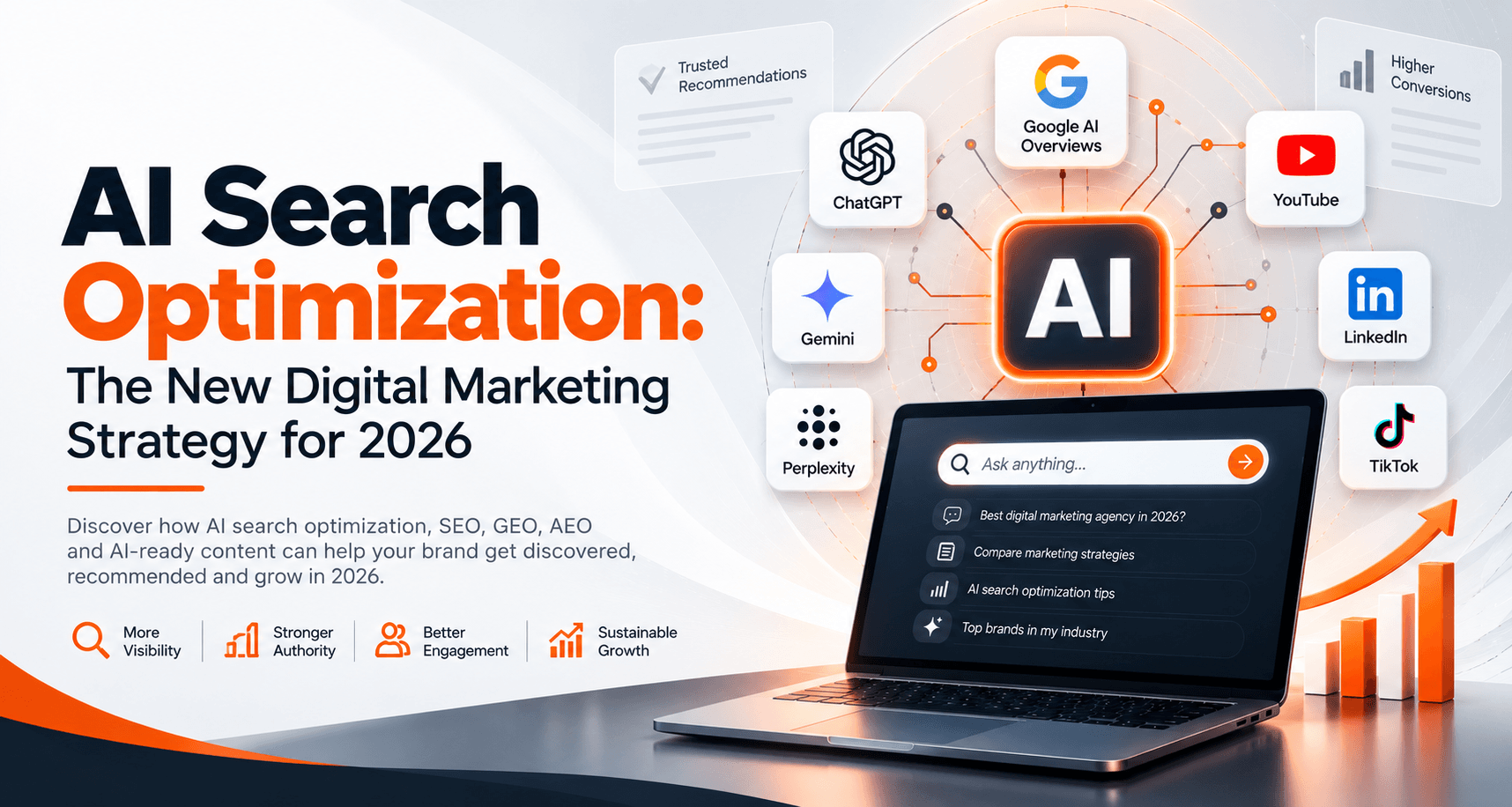
AI Search Optimization: The New Digital Marketing Strategy for 2026
How businesses can extend their SEO strategy into AI-powered search, build authority, improve discovery and turn AI visibility into measurable business results.
For more than two decades, digital marketing has revolved around one fundamental question:
In 2026, that question is changing.
Customers are increasingly using AI-powered search and conversational tools to research products, compare companies, discover services, understand complex topics and make purchasing decisions.
Instead of searching:
a customer may ask:
Instead of receiving only a list of links, the user may receive a synthesized answer containing recommendations, explanations and links to supporting sources.
This is creating a new discipline commonly called AI Search Optimization.
It overlaps with:
- SEO
- GEO
- AEO
- Content marketing
- Digital PR
- Brand building
- E-E-A-T
- Conversion optimization
AI Search Optimization is not about replacing SEO. It is about extending your search strategy into an increasingly AI-driven discovery environment.
Google's current guidance confirms that traditional SEO fundamentals remain foundational for its generative AI search experiences, including AI Overviews and AI Mode.
So what exactly should businesses do in 2026?
Let's break it down.
- What Is AI Search Optimization?
- Why AI Search Optimization Matters in 2026
- AI Search vs Traditional Search
- Is SEO Still Important in 2026?
- SEO vs AI Search Optimization
- The 7 Pillars of AI Search Optimization
- Build a Strong Technical SEO Foundation
- Optimize for Search Intent
- Create Content That Provides Unique Value
- Demonstrate E-E-A-T
- Optimize Your Brand as an Entity
- Build Topical Authority
- Optimize for Questions
- AEO and AI Search Optimization
- GEO and AI Search Optimization
- How ChatGPT Changes Search Optimization
- How Gemini Changes Search Optimization
- How Perplexity Changes Search Optimization
- AI Search Optimization Requires More Than Blog Posts
- Digital PR Is Becoming More Important
- Optimize for Multimodal Search
- AI Search Optimization for Local Businesses
- AI Search Optimization for E-Commerce
- AI Search Optimization for B2B Companies
- Don't Create Hundreds of AI-Generated Pages
- Don't Chase AI Search Hacks
- How to Measure AI Search Optimization
- Google Search Console and Generative AI Visibility
- A Practical AI Search Optimization Strategy
- 90-Day AI Search Optimization Plan
- AI Search Optimization Checklist
- Frequently Asked Questions
- The Future of Digital Marketing Is Search Everywhere
- Final Takeaway
What Is AI Search Optimization?
AI Search Optimization is the practice of improving a brand's website, content, authority and digital presence so that it can be discovered, understood, represented and potentially cited or recommended within AI-powered search experiences.
These experiences can include:
- Google AI Overviews
- Google AI Mode
- ChatGPT Search
- Gemini-powered search experiences
- Perplexity
- Other AI-powered answer and discovery systems
Traditional SEO primarily focuses on helping search engines understand and rank web pages.
AI Search Optimization expands the objective.
Help search systems and AI models understand the brand, its expertise, its content and its relevance to specific customer questions.
That means businesses need to think about more than keywords.
They need to think about:
Why AI Search Optimization Matters in 2026
Search behavior is becoming more conversational.
People can ask increasingly detailed questions instead of entering short keyword phrases.
For example:
Traditional search
AI search
The second query contains:
- Location
- Industry
- Business model
- Budget
- Service
- Selection criteria
AI-powered search systems can use this context to provide a more specific response.
Google describes AI Mode as being particularly useful for complex questions, comparisons and exploration, while its AI search systems can use a technique called query fan-out to explore related subtopics and sources.
That changes what businesses should publish.
Instead of optimizing one page for:
“SEO agency”
you may need a content ecosystem that demonstrates expertise around:
- SEO strategy
- B2B SEO
- SaaS SEO
- Local SEO
- Technical SEO
- Content marketing
- AI SEO
- GEO
- AEO
- Lead generation
- Conversion optimization
The objective is to become topically relevant, not simply keyword relevant.
AI Search vs Traditional Search
The traditional search journey often looks like:
An AI-assisted journey may look more like:
Question → AI research → Synthesized answer → Sources → Brand discovery → Comparison → Website → Conversion
This doesn't mean traditional search is disappearing.
It means the customer journey is becoming more fragmented.
Your potential customer could discover your brand through:
- Google Search
- Google AI Overviews
- Google AI Mode
- ChatGPT
- Gemini
- Perplexity
- YouTube
- Industry publications
- Reviews
- Podcasts
- Social media
Your digital marketing strategy therefore needs to account for multiple discovery environments.
Is SEO Still Important in 2026?
Absolutely.
This is one of the most important points businesses should understand.
Google's official 2026 guide states that SEO best practices continue to be relevant because generative AI features are rooted in Google's core Search ranking and quality systems.
Google specifically recommends continuing to focus on:
- Crawlability
- Indexability
- Internal linking
- Page experience
- Textual content
- Structured data
- Helpful content
- Search Essentials
- High-quality images and videos
- Accurate Business Profile information
Google also says there are no additional technical requirements or special schema specifically required for AI Overviews or AI Mode.
So the idea that businesses need to abandon SEO and replace it with a completely separate “AI SEO” system is misleading.
SEO vs AI Search Optimization
| Traditional SEO | AI Search Optimization |
|---|---|
| Focuses on search visibility | Focuses on search + AI discovery |
| Keywords | Topics, entities and intent |
| Rankings | Visibility, mentions, citations and rankings |
| Web pages | Information ecosystem |
| Search queries | Conversational questions |
| Organic traffic | Discovery + qualified traffic + conversions |
| Backlinks | Authority + relevant mentions |
| SERPs | SERPs + AI answers |
| Search engines | Search engines + AI systems |
These are not competing strategies.
AI Search Optimization builds on SEO.
The 7 Pillars of AI Search Optimization
A strong 2026 strategy can be organized into seven pillars:
Technical SEO
Make your website accessible.
Search Intent
Understand what customers actually want.
Helpful Content
Provide information that genuinely solves problems.
E-E-A-T
Demonstrate experience, expertise, authority and trust.
Entity & Brand Optimization
Make your company and expertise easy to understand.
Digital Authority
Earn legitimate mentions and references from credible sources.
Conversion Optimization
Turn discovery into measurable business results.
Together, these create an AI-ready digital marketing ecosystem.
Build a Strong Technical SEO Foundation
AI search cannot reliably use information it cannot discover or process.
Your first step should therefore be technical SEO.
Audit:
- Robots.txt
- XML sitemap
- Indexability
- Canonical URLs
- Internal links
- Redirects
- Broken links
- JavaScript rendering
- Mobile usability
- Core page experience
- Duplicate content
- Site architecture
Google's AI-search documentation specifically says that pages need to meet the normal technical requirements for Google Search and be indexed to be eligible as supporting links in AI features.
Keep important content accessible
Don't hide critical information only behind:
- Images
- Complex JavaScript
- Interactive widgets
- PDFs
- Login walls
Important information should be available as crawlable text wherever appropriate.
Google also recommends making content easily discoverable through internal links.
Optimize for Search Intent, Not Just Keywords
Keyword research is still important.
But keyword research alone isn't enough.
Consider:
Keyword: AI search optimization
A basic article might define the term.
A better article answers:
- What is AI search optimization?
- Why does it matter?
- How is it different from SEO?
- What does GEO mean?
- What does AEO mean?
- How do ChatGPT and Gemini discover information?
- How should businesses optimize their websites?
- What should businesses measure?
- What mistakes should they avoid?
This creates a more complete answer.
AI systems can better understand content when the underlying subject is covered comprehensively and logically.
Create Content That Provides Unique Value
This may be the most important principle in AI Search Optimization.
If your article simply summarizes what 20 other websites have already said, why should your brand become a preferred source?
Google's current guidance specifically emphasizes unique, valuable, non-commodity content and recommends providing original information, analysis and first-hand experience.
Instead of:
Create:
“We analyzed 100 search queries across five industries and identified three recurring patterns in how AI-generated answers represent service businesses.”
The second contains original information.
That is much more valuable.
Demonstrate E-E-A-T
AI Search Optimization and E-E-A-T should work together.
Google describes E-E-A-T as:
Google also emphasizes that trust is the most important component and recommends making authorship clear where readers would expect it.
Experience
Show what your team has actually done.
Use:
- Case studies
- Campaign examples
- Screenshots
- Experiments
- Client results
- Original research
Expertise
Demonstrate professional knowledge.
Use:
- Expert articles
- Author profiles
- Industry analysis
- Frameworks
- Research
Authority
Earn recognition.
Use:
- Industry publications
- Interviews
- Podcasts
- Partnerships
- Conferences
- Relevant backlinks
Trust
Make your business transparent.
Include:
- Real company information
- Contact details
- Author information
- Privacy policies
- Terms
- Reviews
- Accurate claims
Optimize Your Brand as an Entity
AI search isn't just about individual webpages.
It's increasingly about understanding entities and relationships.
For example:
Trivia Digital Agency
is an entity.
Its relationships might include:
Trivia Digital Agency → Digital Marketing Agency
Trivia Digital Agency → Bangalore
Trivia Digital Agency → SEO
Trivia Digital Agency → Content Marketing
Trivia Digital Agency → Web Design
Trivia Digital Agency → AI Search Optimization
The clearer these relationships are across your digital ecosystem, the easier it becomes for search systems to understand what your company represents.
Your website should clearly communicate:
- Who you are
- What you do
- Who you serve
- Where you operate
- What industries you specialize in
- What services you provide
- What makes you different
Build Topical Authority
One article about AI search isn't enough to establish expertise.
Build a topic cluster.
Pillar
AI Search Optimization
Supporting articles
- What Is AI Search Optimization?
- AI Search vs Traditional Search
- GEO vs SEO vs AEO
- How to Get Your Brand Recommended by ChatGPT
- How to Appear in Google AI Overviews
- ChatGPT SEO
- Gemini SEO
- Perplexity SEO
- AI Search Visibility
- AI Search Ranking Factors
- AI Content Optimization
- E-E-A-T for AI Search
- Digital PR for AI Visibility
Then connect these pages through contextual internal links.
This creates a clear topical architecture.
Optimize for Questions
AI search is naturally conversational.
That means question-based content deserves a bigger role in your strategy.
Target questions such as:
Informational
Comparison
Commercial
Problem solving
Decision making
Local
Build content around the actual questions your customers ask.
AEO and AI Search Optimization
AEO, or Answer Engine Optimization, focuses on making content easier for answer-oriented systems to understand and use.
Useful formats include:
- Direct definitions
- Question-and-answer sections
- Step-by-step guides
- Tables
- Comparisons
- FAQs
- Lists
- Concise summaries
For example:
What is AI Search Optimization?
AI Search Optimization is the practice of improving a website, content and brand presence so that they can be discovered and understood within AI-powered search experiences.
Then expand with examples, evidence and practical advice.
This structure benefits users first.
It can also make the information easier for answer systems to interpret.
GEO and AI Search Optimization
GEO, or Generative Engine Optimization, is commonly used to describe efforts focused specifically on visibility within generative AI experiences.
The terminology isn't perfectly standardized.
Google's current guidance says that from its perspective, optimizing for generative AI search is still optimizing for the search experience—and therefore still SEO. Google also cautions against treating AEO/GEO as a collection of special “hacks.”
A practical GEO strategy can include:
- Original research
- Expert content
- Strong topical authority
- Consistent brand information
- Digital PR
- Relevant third-party mentions
- Clear authorship
- Strong source attribution
- Helpful comparisons
- Comprehensive answers
The goal is not to manipulate an AI system.
The goal is to become a credible source that AI systems can understand and users can trust.
How ChatGPT Changes Search Optimization
ChatGPT can search the web and provide current information with citations and links. OpenAI states that public websites can appear in ChatGPT Search and that websites should allow OAI-SearchBot if they want content to be eligible for discovery and citation.
This creates an important technical consideration.
Check your robots.txt
Make sure your important public pages aren't unintentionally blocking OAI-SearchBot.
Allowing the crawler does not guarantee visibility.
OpenAI says ChatGPT ranks search results using multiple factors and that placement is not guaranteed.
So crawlability is only the beginning.
You still need:
- Relevant content
- Strong information architecture
- Authority
- Clear positioning
- Useful answers
- Up-to-date information
How Gemini Changes Search Optimization
Gemini and Google's AI search experiences are closely connected to Google's broader Search ecosystem.
That makes traditional SEO fundamentals particularly important.
Google recommends:
- Crawlable content
- Strong internal linking
- Useful textual content
- Good page experience
- Accurate structured data
- High-quality images and videos
- Updated Business Profile and Merchant Center information
for its AI search experiences.
Therefore, a business should not build one website for Google and another “AI website” for Gemini.
Build one excellent website.
How Perplexity Changes Search Optimization
Perplexity describes itself as an AI-powered search engine that searches the web, synthesizes information and provides citations to original sources.
Its current source-labeling system also evaluates characteristics such as:
- Who wrote the content
- Whether the website corrects mistakes
- Whether advertising and opinion are separated
- Whether the site operates within its area of expertise
Some domains can receive Government, Academic or Trusted labels.
Source quality and editorial credibility matter.
Invest in:
- Expert authors
- Original research
- Clear editorial standards
- Accurate claims
- Author pages
- Updated content
- Credible external references
AI Search Optimization Requires More Than Blog Posts
A common mistake is thinking:
AI Search Optimization = AI blog content
It doesn't.
Your entire digital presence matters.
Website
Your website establishes your core identity.
Content
Your content demonstrates expertise.
Digital PR
Third-party sources establish authority.
Social media
Social platforms distribute expertise and brand signals.
Video
YouTube and other video platforms create additional discoverability.
Reviews
Reviews provide customer-generated evidence.
Communities
Relevant communities can expose your brand to new audiences.
Business profiles
Local and industry profiles reinforce business information.
AI search optimization is therefore increasingly an ecosystem strategy.
Digital PR Is Becoming More Important
Traditional SEO often emphasized links.
Modern AI search requires a broader view of authority.
A relevant article in an industry publication can:
- Introduce your brand
- Validate your expertise
- Generate a referral
- Create a backlink
- Provide another source for discovery
- Strengthen brand recognition
This is why digital PR can complement SEO and AI Search Optimization.
Example
A digital marketing agency publishes:
“2026 AI Search Visibility Report: How 500 Businesses Appear in AI Search.”
Then:
Marketing publications cite it.
Industry experts discuss it.
Podcasts interview the authors.
Other websites reference the findings.
The agency has created an authority asset.
That's much more powerful than publishing another generic:
article.
Optimize for Multimodal Search
AI search isn't limited to text.
Google's current guidance emphasizes supporting text with high-quality images and videos where appropriate, especially as search becomes more multimodal.
Your AI Search Optimization strategy should therefore include:
- Images
- Infographics
- Videos
- Product demonstrations
- Screenshots
- Charts
- Diagrams
- YouTube content
For example, a software company could create:
This gives users and search systems multiple ways to understand the topic.
AI Search Optimization for Local Businesses
Local businesses should combine:
Local SEO + AI Search Optimization
Make sure your:
- Business name
- Address
- Phone
- Website
- Services
- Opening hours
- Business category
- Reviews
- Location
- Service areas
are accurate.
Then create useful local content.
This gives your brand stronger relevance for location-based questions.
AI Search Optimization for E-Commerce
E-commerce businesses have additional opportunities.
Optimize:
- Product pages
- Product descriptions
- Product attributes
- Images
- Reviews
- FAQs
- Comparison content
- Buying guides
- Merchant Center information
Don't rely solely on manufacturer descriptions.
Create original buying information.
For example:
is more valuable than simply:
AI-powered search increasingly favors contextual information.
AI Search Optimization for B2B Companies
B2B customers often conduct extensive research before contacting a vendor.
They may ask:
Then:
Then:
Your content should support the entire journey.
Awareness
Educational content.
Consideration
Comparison guides.
Evaluation
Case studies.
Decision
Service/product pages.
Trust
Reviews, credentials and third-party recognition.
This is where AI Search Optimization becomes closely connected with B2B demand generation.
Don't Create Hundreds of AI-Generated Pages
This is one of the biggest mistakes businesses can make.
AI makes it incredibly easy to generate content.
But easy production does not equal useful content.
Google explicitly warns that generating many pages with AI without adding value can violate its scaled-content-abuse policies.
Instead, use AI to:
- Research
- Analyze
- Brainstorm
- Organize
- Summarize
- Identify gaps
- Assist with drafts
Then add:
- Human expertise
- First-hand experience
- Original research
- Unique examples
- Editorial judgment
- Fact checking
Google's guidance is clear that AI itself isn't the issue; quality, originality, usefulness and intent matter.
Don't Chase AI Search “Hacks”
The AI search industry is full of claims such as:
Be skeptical.
Google's 2026 generative-AI guidance specifically says businesses can ignore tactics such as unnecessary AI text files like llms.txt, artificial content “chunking” and inauthentic mentions as supposed requirements for generative AI visibility.
The better strategy is much less complicated:
Make your website useful.
Make it technically accessible.
Demonstrate expertise.
Publish original information.
Build legitimate authority.
How to Measure AI Search Optimization
Traditional SEO reporting often focuses on:
- Rankings
- Impressions
- Clicks
- Traffic
Those metrics still matter.
But AI Search Optimization requires additional measurement.
Search visibility
- Organic rankings
- Impressions
- Click-through rate
AI visibility
- AI Overview appearances
- AI Mode visibility
- AI citations
- Brand mentions
- AI recommendations
- Competitor visibility
Brand
- Branded searches
- Direct traffic
- Brand mentions
- Share of search
Business
- Qualified leads
- Conversion rate
- Sales
- Revenue
- Customer acquisition cost
The ultimate objective isn't:
“How many times did AI mention us?”
It's:
“Did improved discovery create business value?”
Google Search Console Now Provides Generative AI Visibility Data
This is one of the most important developments for marketers in 2026.
Google introduced dedicated Search Generative AI performance reports in Search Console to provide visibility into impressions from generative AI features such as AI Overviews and AI Mode. Google announced that these insights had rolled out worldwide by August 31, 2026.
This changes how agencies can measure AI search optimization.
Instead of relying entirely on manual prompt testing, marketers can increasingly combine:
to understand how AI search affects visibility and business performance.
A Practical AI Search Optimization Strategy for 2026
Here's a simple framework businesses can follow.
Audit
Review:
- Technical SEO
- Indexability
- Internal linking
- Content quality
- Brand consistency
- Business profiles
- Author information
- Structured data
- Digital authority
Build
Create:
- Core service pages
- Topic clusters
- Expert guides
- Comparison pages
- FAQ content
- Case studies
- Original research
Strengthen Authority
Invest in:
- Digital PR
- Industry publications
- Expert interviews
- Podcasts
- Partnerships
- Research citations
Optimize AI Discovery
Review:
- ChatGPT visibility
- Gemini visibility
- Perplexity visibility
- Google AI Overviews
- AI Mode
- Brand representation
- Competitor representation
Measure
Track:
Not simply:
90-Day AI Search Optimization Plan
Month 1: Foundation
Week 1
Technical SEO audit.
Week 2
Content and search-intent audit.
Week 3
Brand/entity consistency audit.
Week 4
Create AI search visibility baseline.
Month 2: Content & Authority
Publish:
- 1 pillar guide
- 4–6 supporting articles
- 1 original research piece
- 1 case study
- Expert-led content
Strengthen internal links.
Begin digital PR.
Month 3: AI Visibility & Conversion
Monitor:
- AI mentions
- AI citations
- Search Console generative AI impressions
- Organic visibility
- Brand searches
- Referral traffic
- Leads
- Conversion rate
Improve pages based on real search behavior.
AI Search Optimization Checklist
Before publishing an important page, ask:
Technical SEO
Content
E-E-A-T
AI Search
Authority
Conversion
Frequently Asked Questions
What is AI Search Optimization?
AI Search Optimization is the practice of improving a website, content and brand presence so that they can be discovered, understood and potentially surfaced within AI-powered search experiences.
Is AI Search Optimization the same as SEO?
No, but they overlap heavily. Google states that its generative AI search experiences are rooted in core Search systems and that foundational SEO best practices remain relevant.
What is the difference between SEO and AI SEO?
Traditional SEO focuses on organic search visibility. AI SEO is a broader industry term often used for optimizing a website and brand for search experiences that increasingly incorporate generative AI.
What is GEO?
GEO stands for Generative Engine Optimization. It is commonly used to describe efforts to improve visibility within generative AI search experiences.
What is AEO?
AEO stands for Answer Engine Optimization. It focuses on making information clear and useful for answer-oriented search experiences.
How do I optimize my website for AI search?
Start with technical SEO, crawlability, strong internal linking, useful original content, clear answers, strong topical authority, genuine E-E-A-T and accurate brand information. Google says there are no special AI-only technical requirements or schema needed for AI Overviews or AI Mode.
How do I get my website into ChatGPT Search?
Make your public website crawlable and ensure you are not blocking OAI-SearchBot if you want content to be eligible for discovery and citation. OpenAI notes that inclusion and placement are not guaranteed.
How can I appear in Google AI Overviews?
Follow Google's normal Search technical requirements and SEO best practices, create useful and original content, and make sure important information is crawlable and indexable. Google says there are no additional technical requirements specifically for AI Overviews.
How can I improve my Perplexity visibility?
Publish authoritative, original and clearly sourced information. Perplexity searches the web and synthesizes information from sources with citations, so being a credible source can improve your opportunity to be discovered.
Does AI-generated content help AI search optimization?
Not automatically. AI can assist with research and content creation, but Google emphasizes original, helpful, people-first content and warns against producing large quantities of low-value AI-generated pages.
Is GEO more important than SEO in 2026?
For most businesses, it shouldn't be an either/or decision. SEO remains the foundation, while GEO and AEO can be treated as additional approaches to visibility in AI-driven search experiences.
The Future of Digital Marketing Is Search Everywhere
The biggest change in digital marketing in 2026 isn't simply that AI can generate answers.
It's that the search journey itself is changing.
Customers can now discover businesses through:
Google → AI Overviews → AI Mode → ChatGPT → Gemini → Perplexity → Social → Video → Communities → Brand Website
The brands that succeed will not necessarily be the brands publishing the most content.
They will be the brands that provide the best information, strongest expertise and clearest answers.
That means your 2026 digital marketing strategy should focus on:
SEO
For technical and organic visibility.
AEO
For clear answers.
GEO
For generative discovery.
E-E-A-T
For trust.
Digital PR
For authority.
Content Marketing
For expertise.
CRO
For revenue.
AI
To make the entire process more efficient.
Final Takeaway
AI Search Optimization is not a replacement for SEO.
It is the next evolution of how businesses think about digital discovery.
The old question was:
The new question is:
“How do I become a trusted source wherever my customers search?”
That requires more than keywords.
It requires:
Google's latest guidance makes the principle clear: create useful, unique, people-first content and maintain strong SEO foundations rather than chasing artificial GEO or AEO hacks.
In 2026, the strongest digital marketing strategy isn't about optimizing for one search engine.
It's about building a brand that can be:
Found.
Understood.
Trusted.
Cited.
Recommended.
Chosen.
That's the real opportunity of AI Search Optimization.
Build a Brand That Gets Found, Understood & Chosen.
Build the SEO, content, authority and conversion foundation your business needs for the next generation of search.
Trivia Digital Agency can help you build an AI-ready digital marketing strategy for 2026 and beyond.
Start a Conversation → Explore Trivia →