How AI Is Changing Meta and Google Ads Campaign Management
Discover how AI is transforming Google Ads and Meta Ads through automated bidding, audience discovery, creative optimisation and smarter conversion measurement—and what marketers need to do to generate profitable results.
Artificial intelligence is no longer an optional add-on to paid advertising. In 2026, AI is built directly into how Google Ads and Meta Ads identify audiences, evaluate intent, set bids, choose placements, generate creative variations, allocate budgets and measure conversions.
This shift has created a new model of AI PPC management. Marketers are spending less time adjusting individual bids or building dozens of tightly controlled audience segments and more time deciding what outcomes the platforms should optimise toward, what data they should learn from and what creative inputs they should receive.
Businesses looking to connect paid advertising with broader acquisition strategies can explore our performance marketing services in Bangalore.
The important point is that AI has not eliminated the need for campaign management. It has changed what good campaign management looks like.
Quick Answer: How Is AI Changing Google and Meta Ads?
AI is moving Google Ads and Meta Ads campaign management from manual optimisation toward automated, signal-driven decision-making.
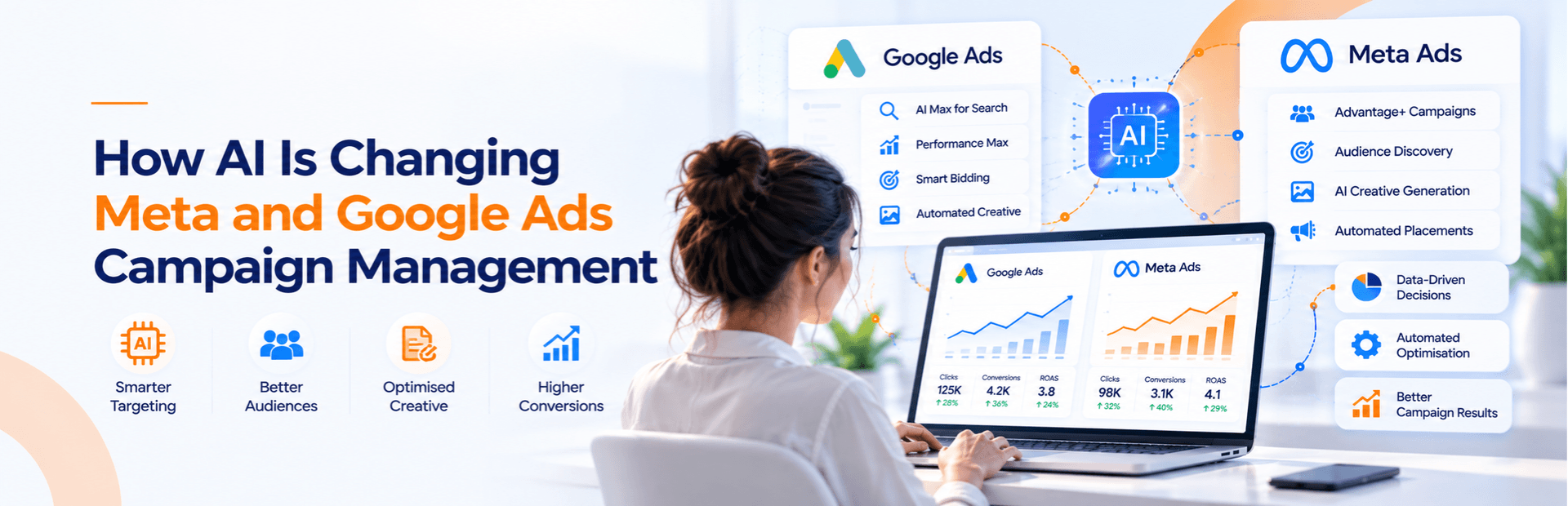
Google increasingly uses AI through technologies such as AI Max for Search, Performance Max, Smart Bidding and automated creative optimisation. Meta uses AI across its Advantage+ ecosystem, audience discovery, placements, creative generation, ad ranking and campaign optimisation.
The platforms can therefore automate more execution than before. But marketers still need to control strategy, conversion tracking, commercial targets, creative direction, lead quality, experimentation and measurement.
For a broader view of how AI is transforming customer acquisition, read our guide to digital marketing in 2026 and AI-driven customer acquisition.
What Is AI PPC Management?
AI PPC management is the use of artificial intelligence, machine learning and automation to manage or support pay-per-click advertising activities.
Instead of relying entirely on manual rules, AI can analyse large numbers of signals and make campaign decisions in real time.
Those signals can include search behaviour, previous conversions, audience characteristics, device, location, time, creative performance, landing-page relevance and predicted conversion probability.
For businesses, this means paid advertising is becoming less about micromanaging every campaign setting and more about building a strong system of data + creative + objectives + measurement + human oversight.
How AI Is Changing Google Ads
Google Ads has used machine learning for years, particularly in bidding. What has changed is how deeply AI now influences the entire campaign.
1. Search Campaigns Are Moving Beyond Traditional Keywords
AI Max for Search is one of the clearest examples.
AI Max is not a separate campaign type. Google describes it as an optimisation layer for existing Search campaigns. It can expand search-term matching, customise ad text and use final URL expansion to connect users with more relevant pages based on their intent.
Instead of asking only, “Which exact keyword did this person type?”, campaign management increasingly asks:
What is this person actually trying to accomplish, and which combination of query, ad and landing page is most likely to convert them?
Google says advertisers activating AI Max typically see more conversions or conversion value at similar CPA or ROAS, although those figures come from Google's own internal data and should not be treated as a performance guarantee.
Google has also continued adding controls and reporting to AI Max. In September 2026, it announced reporting designed to show the journey from the search term through the creative shown to the landing page visited, giving advertisers more visibility into AI-driven decisions.
To understand how AI is changing search visibility beyond traditional search results, read our article on AI search optimization in 2026.
2. Bidding Is Becoming Predictive Rather Than Reactive
Manual bidding reacts to past performance.
AI-powered bidding attempts to predict future performance.
Google's Smart Bidding uses AI at auction time to optimise for conversions or conversion value. Strategies include Target CPA, Target ROAS, Maximise Conversions and Maximise Conversion Value.
That allows the system to evaluate many signals for each individual auction rather than applying one static bid to every user.
For lead-generation businesses, this is moving another step forward.
Google announced journey-aware bidding in 2026, designed to help Search campaigns learn from more of the lead-to-sale journey rather than only the initial form submission. Google is also expanding Smart Bidding Exploration to identify valuable searches outside the most obvious demand patterns.
This makes CRM and offline-sales data increasingly important.
Businesses that want to improve campaign profitability should connect bidding strategies with clear commercial objectives. Our performance marketing agency in Bangalore helps businesses align paid campaigns with lead generation, conversion optimisation and measurable performance goals.
3. Performance Max Has Made Cross-Channel Automation Standard
Performance Max uses Google AI across Search, YouTube, Display, Discover, Gmail and Maps within one goal-based campaign.
Google combines advertiser inputs such as conversion goals, assets, audience signals and bidding targets with its own AI predictions to determine where and how ads should appear.
For marketers, this means campaign architecture has shifted.
The question is no longer simply:
Should we increase our Search bid?
It may instead be:
Which channel, audience, asset and moment deserves the next advertising impression?
AI can make that decision at a scale that manual campaign management cannot realistically match.
4. Creative Optimisation Is Becoming Automated
Google AI increasingly assists with headlines, descriptions, images, asset combinations and landing-page selection.
This creates enormous production efficiency, but it also creates a new problem: creative sameness.
If every advertiser feeds similar prompts, claims and product information into the same systems, the result can become generic.
Strong positioning, original customer insights, distinctive offers and high-quality creative therefore become more important—not less important—as automation increases.
Businesses can strengthen their advertising assets with professional graphic and creative design services in Bangalore, helping maintain a consistent visual identity across campaigns and placements.
How AI Is Changing Meta Ads
Meta has followed a similar direction, but its strongest advantage is its enormous volume of behavioural and creative engagement signals across Facebook, Instagram, Reels and messaging.
AI now influences virtually every stage of the Meta advertising system.
For more on the changing role of social platforms in discovery, content distribution and conversions, read our guide to social media marketing in 2026.
1. Advantage+ Is Reducing Manual Audience Management
Meta's Advantage+ tools use AI to automate or expand campaign setup, audiences, placements and creative decisions.
Traditional Meta campaign management often involved creating numerous interest-based audiences, lookalikes and demographic segments.
Today, advertisers can provide audience suggestions or constraints while allowing Meta's systems to search more broadly for people likely to complete the required action.
The result is a significant shift:
Creative and conversion signals are increasingly becoming the targeting mechanism.
Instead of attempting to predict every potential customer manually, advertisers give Meta strong signals and allow its models to discover patterns at scale.
For businesses that want to turn this automation into a structured acquisition strategy, social media marketing services can support campaign planning, audience engagement and social advertising objectives.
2. AI Is Playing a Bigger Role in Ad Creative
Meta is also increasing its use of generative AI for advertising.
Advertisers can use AI-assisted creative features to produce variations, resize or extend images, adapt assets to placements and generate or modify creative elements. Advantage+ creative, for example, can automatically adjust assets for placements such as Reels.
This allows one creative concept to generate substantially more variations than a traditional production workflow.
The competitive advantage, however, is unlikely to come from simply generating more ads.
It will come from feeding the AI better concepts.
Businesses still need human insight to determine which customer pain point matters, which offer is compelling, which objection needs to be addressed and what makes the brand different.
For campaigns that depend on distinctive visuals, brands can combine AI-assisted workflows with graphic and creative design services and video production services in Bangalore.
3. Meta's Ad Ranking Models Are Becoming More Sophisticated
Behind Ads Manager, AI is also changing how Meta determines which ad to show each person.
Meta reported in early 2026 that improvements to its latest ad-ranking models contributed to increases in Facebook ad clicks and Instagram conversions during Q4 2025. Meta also reported a separate run-time model increasing conversion rates across Instagram Feed, Stories and Reels. These are Meta's own platform-reported results, so they illustrate the direction of the technology rather than guaranteeing similar results for every advertiser.
This matters because modern Meta optimisation is happening at a level advertisers cannot reproduce through manual audience segmentation alone.
4. Messaging Is Becoming Part of Performance Advertising
Meta is also connecting AI advertising more closely with business messaging.
Click-to-message and website-to-message advertising allow leads to move directly from an ad or website into conversations through Meta's messaging ecosystem.
For businesses where WhatsApp or direct conversations play an important role in converting customers, this creates opportunities to optimise around conversations and downstream sales rather than simple website traffic.
A joined-up strategy can combine paid social, search and website experiences to create a more effective customer journey. Businesses can explore our digital marketing agency services in Bangalore for support across these channels.
AI Is Changing the Definition of a “Conversion”
This may be the most important change for lead-generation campaigns.
Imagine two campaigns.
| Metric | Campaign A | Campaign B |
|---|---|---|
| Leads generated | 100 | 60 |
| Cost per lead | ₹500 | ₹700 |
| Customers acquired | 5 | 15 |
At first glance, Campaign A looks better.
But if Campaign A produces five customers while Campaign B produces 15 customers, Campaign B is clearly more valuable.
AI cannot make that distinction unless the advertising platform receives information about what happened after the lead was submitted.
Google now recommends using enhanced conversions for leads and importing qualified or converted lead data back into Google Ads. Enhanced conversions can connect hashed first-party lead information and offline CRM outcomes with the original advertising interaction.
This means businesses need to move beyond optimising only for:
and build measurement around:
When AI receives better signals, its optimisation can become much more commercially useful.
Website usability and conversion paths also matter. A well-structured website can help turn paid traffic into enquiries, which is why landing-page performance should be considered alongside website development services in Bangalore.
What AI Should Manage—and What Humans Should Still Control
| AI is good at | Humans should control |
|---|---|
| Auction-time bidding | Business strategy |
| Audience expansion | Positioning |
| Search-query expansion | Offer development |
| Placement optimisation | Lead-quality definitions |
| Creative combinations | Brand direction |
| Pattern detection | Profitability targets |
| Budget pacing | Attribution decisions |
| Large-scale data processing | Experiment design |
| Routine reporting | Compliance and judgement |
| Generating variations | Final creative approval |
The strongest model is therefore not AI versus human marketers.
It is AI execution guided by human strategy.
How AI Can Improve Lead Generation
AI-powered advertising can create major advantages for lead-generation businesses when the correct infrastructure is in place.
First, campaigns can respond to behavioural signals faster than manual teams. Bids and placements can change at auction time rather than waiting for someone to review yesterday's report.
Second, AI can identify new pockets of demand that rigid keyword lists or audience segments may miss.
Third, creative teams can test more variations. Instead of producing three advertisements per month, businesses can systematically test multiple messages, formats, hooks and visual treatments.
Fourth, advertisers can optimise toward higher-quality outcomes when CRM and offline conversion data are connected correctly.
Finally, automation reduces repetitive campaign work, giving marketers more time for landing-page optimisation, customer research, offer development and strategic experimentation.
For businesses seeking a coordinated approach to lead generation, our performance marketing services combine paid campaign strategy with conversion-focused optimisation and performance measurement.
The Risks of Over-Automating Google and Meta Ads
More automation does not automatically mean better advertising.
The biggest danger is giving AI the wrong objective.
If campaigns are told to maximise form submissions, they may find people who complete forms frequently—not necessarily people who become customers.
Poor conversion tracking creates the same problem. Duplicate events, spam leads or low-value micro-conversions can train automated bidding systems toward the wrong behaviour.
Creative automation also requires controls. AI-generated copy may introduce inaccurate claims, inconsistent branding or messages that technically perform well but weaken the brand.
There is also an attribution challenge. Platform-reported results should not automatically be treated as incremental business results. Strong teams compare platform data with CRM, analytics, revenue and, where appropriate, incrementality testing.
A Better AI PPC Management Framework for 2026
A reliable AI-powered advertising strategy can be built around eight principles:
- Define the real business objective. Decide whether the priority is qualified leads, sales, revenue, profitability, customer acquisition cost or lifetime value before selecting campaign objectives.
- Build accurate conversion tracking. Ensure Google Ads, Meta, analytics tools and your CRM agree on what constitutes a meaningful conversion.
- Send downstream outcomes back to advertising platforms. Whenever possible, distinguish leads from qualified leads and customers.
- Give AI strong creative inputs. Provide different customer problems, benefits, proof points, objections, offers and formats instead of generating dozens of nearly identical ads.
- Simplify where automation needs data. Fragmenting limited conversion volume across excessive campaigns or ad sets can reduce the data available for optimisation.
- Test automation rather than assuming it works. Google provides AI Max experiments so advertisers can evaluate AI-driven Search changes before applying them more broadly.
- Judge performance using business metrics. Track qualified CPL, CAC, ROAS, revenue, conversion rate and lead-to-customer rate—not only CTR, CPC or platform lead totals.
- Maintain human oversight. Review search terms, placements, creative outputs, landing pages, customer quality and budget allocation regularly.
A comprehensive strategy should also consider the wider shift in how customers discover brands through traditional search and AI-powered platforms. Our article on GEO vs SEO vs AEO in 2026 explains how these approaches differ and where they overlap.
Will AI Replace Google Ads and Meta Ads Specialists?
AI will replace parts of the old PPC workflow.
It is already reducing the need for repetitive bid adjustments, manual placement selection, basic audience expansion and some types of routine reporting.
But that does not eliminate the need for specialists.
It changes the specialist's job.
The modern PPC professional increasingly needs to understand business economics, attribution, first-party data, creative strategy, experimentation, landing-page optimisation and AI systems.
In other words, the value is shifting from knowing where every button is inside Ads Manager to knowing what the advertising system should be trying to achieve.
The same shift is affecting the wider marketing industry. Read our article on how to get your brand recommended by ChatGPT, Gemini and Perplexity to understand why brand visibility, useful content and clear positioning matter across digital discovery channels.
Frequently Asked Questions
How is AI used in Google Ads?
Google Ads uses AI for auction-time bidding, search-term matching, audience signals, Performance Max campaigns, creative optimisation, forecasting and campaign automation. AI Max also extends AI-powered optimisation within Search campaigns.
How is AI used in Meta Ads?
Meta uses AI to rank advertisements, identify audiences, optimise placements, generate creative variations, automate campaign elements and predict which users are most likely to complete a desired action.
What is AI PPC management?
AI PPC management is the use of artificial intelligence and machine learning to automate or assist paid advertising activities such as bidding, targeting, creative testing, budget management, analysis and optimisation.
Can AI manage Google Ads automatically?
AI can manage many elements of Google Ads automatically, but businesses should not operate campaigns without oversight. Strategy, tracking accuracy, commercial targets, creative quality and conversion definitions still require human judgement.
Is Meta Advantage+ better than manual targeting?
It depends on the account, data, objective and creative quality. Advantage+ can discover audiences at a scale manual targeting cannot easily reproduce, but advertisers should test performance against business outcomes rather than assume automation will always outperform a controlled strategy.
Can AI reduce cost per lead?
It can improve bidding, audience discovery and optimisation, but a lower CPL is not guaranteed. More importantly, businesses should optimise toward qualified cost per lead and customer acquisition cost, because generating inexpensive but low-quality leads can reduce profitability.
Will AI replace PPC agencies?
AI is more likely to change agencies than eliminate them. Agencies focused mainly on manual execution may lose value, while teams specialising in strategy, measurement, creative, CRO, first-party data and business outcomes may become more valuable.
The Future of Google and Meta Ads Is AI-Assisted, Not AI-Only
The biggest change in paid advertising is not that AI can write an ad or automatically change a bid.
It is that campaign management is moving from manually controlling thousands of individual decisions toward designing the system that makes those decisions.
Google AI Max, Performance Max, Smart Bidding and Meta Advantage+ can analyse more signals and respond faster than any human campaign manager.
But AI still needs direction.
The businesses that get the strongest results will be those that combine automation with accurate conversion data, differentiated creative, strong offers, clean measurement and experienced human judgement.
The future of Google Ads and Meta Ads management is therefore not “set it and forget it.”
If your business is looking to improve paid advertising performance, lead quality and conversion measurement, contact Trivia Digital Agency to discuss your campaign objectives and growth opportunities.
Make Your Paid Campaigns Work Smarter
Connect Google Ads, Meta Ads, conversion tracking and creative strategy with a performance-focused approach built around qualified leads and measurable business outcomes.
Talk to Trivia Digital Agency