
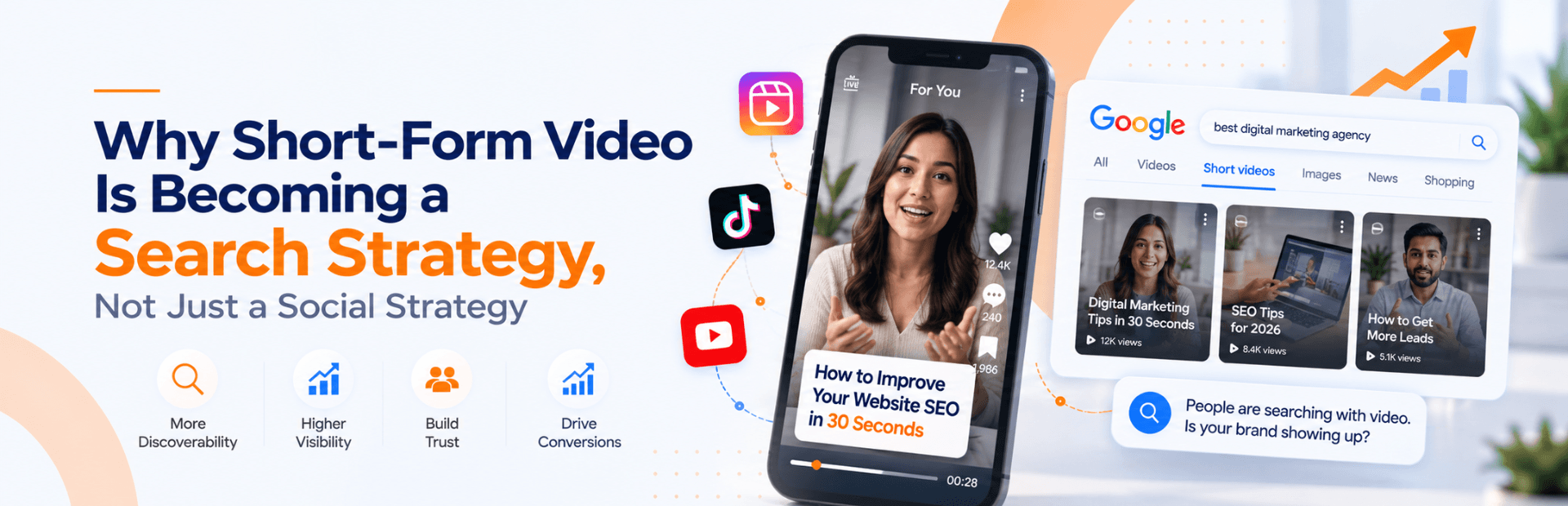
Why Short-Form Video Is Becoming a Search Strategy, Not Just a Social Strategy
Discover how short-form video is evolving from a social engagement format into a searchable digital asset across TikTok, Instagram, YouTube, Google and AI-powered discovery.
What Is Short-Form Video SEO?
Short-form video SEO is the process of creating and optimising short videos so they can be discovered when users search for relevant topics.
That discovery can happen through TikTok Search, Instagram Search, YouTube Search, Google Search or increasingly through AI-powered and multimodal search experiences.
The objective is therefore different from traditional social media publishing.
A conventional social strategy often focuses on followers, trends, reach and engagement immediately after publishing. A search-led video strategy focuses on search intent, topic relevance, discoverability and long-term visibility.
For example, instead of publishing a Reel called:
“3 Things You Need to Know”
a search-led version might focus on:
“3 Ways to Improve Your Website SEO in 2026”
The second version immediately establishes the topic, answers a recognisable search intent and gives both users and platforms clearer context.
That is the foundation of social search optimisation .
Search Behaviour Is Moving Beyond Traditional Search Engines
Google remains enormously important, but search behaviour is becoming fragmented across multiple platforms.
People may Google a broad topic, search TikTok for a demonstration, watch YouTube Shorts for quick explanations, check Instagram for examples and then return to Google or an AI assistant for deeper research.
Short-form video fits naturally into this behaviour because many searches are easier to answer visually.
Someone searching for “how to fold a travel shirt”, “best trousers for long flights”, “how to style a white shirt”, “best coworking space in Kochi” or “how to optimise a Shopify product page” may prefer a 30-second demonstration to a 1,500-word article.
This does not mean traditional SEO is disappearing.
It means search is becoming multi-platform, multimodal and more visual.
A 2026 Adobe Express study of US consumers found that 49% of respondents used TikTok as a search engine, up from 41% in its 2024 research. Video tutorials were also the most preferred type of TikTok search content among respondents.
For marketers, the message is clear: search demand now exists both inside and outside traditional search engines.
Why Short-Form Video Is Becoming a Search Channel
Several changes are driving this transition.
Social Platforms Now Have Strong Search Behaviour
TikTok itself recognises search as an important discovery behaviour.
Its Creator Search Insights tool allows creators to explore subjects people are searching for and identify “content gaps” — topics receiving searches but comparatively limited content.
This changes content planning.
Instead of asking:
“What should we post this week?”
a business can ask:
“What is our audience already searching for?”
That is much closer to traditional keyword research than conventional social media planning.
YouTube works similarly. YouTube explains that its search systems assess factors including relevance, engagement and quality. Relevance can include how closely a video's title, description, tags and actual video content match a user's query.
In other words, the video itself is part of the searchable information.
Short-Form Video Can Extend Beyond the Social Platform
The boundary between social content and search-engine content is also becoming less rigid.
Eligible public content from professional Instagram accounts can be made available to external search engines, creating opportunities for Reels and other public Instagram content to receive visibility beyond Instagram itself.
YouTube content is deeply integrated with Google Search, while Google can display videos across standard search results, video results, images and other search experiences.
This creates an important strategic change.
A short video should no longer be treated as content that exists only inside a social feed.
The same subject can support:
a Reel or TikTok for discovery, a YouTube Short for video search, a detailed website article for organic search, and supporting video content for Google and AI-powered discovery.
The result is a connected search ecosystem, rather than separate SEO and social media campaigns.
AI Search Makes Visual Content Even More Important
AI Overviews, AI Mode and other generative search experiences are also changing how content is discovered.
Google's current guidance makes an important point: there is no completely separate set of technical requirements for appearing in its generative AI search experiences.
Traditional SEO fundamentals still matter.
Pages need to be crawlable, indexable, useful and relevant.
However, Google also explicitly encourages websites to provide high-quality images and video where they genuinely help users, because generative search experiences can surface relevant visual information.
That makes multimedia increasingly valuable.
Imagine publishing a detailed article explaining how to select travel trousers.
The page could contain written comparisons, original product photography, a short demonstration video, specifications, FAQs and first-hand information.
That gives search systems considerably more useful material than a generic AI-generated article containing nothing except text.
For SEO, AEO, GEO and AI search optimisation, depth of useful information is becoming more important than simply producing more words. See our guide to GEO vs SEO vs AEO for a broader framework.
Search Strategy vs Social Strategy
The difference is primarily one of intent.
A social-first video might be created around a trending sound because it has the potential to receive immediate reach.
A search-first video starts with a question.
For example:
“How do managed offices reduce business overheads?”
“Which trousers are best for long-haul flights?”
“How do I optimise Instagram Reels for search?”
“What is technical SEO?”
“Coworking space vs managed office: what is the difference?”
These questions have identifiable intent.
Someone searching them is actively trying to understand, compare, solve or decide something.
That makes search-led short-form video particularly useful for brands selling products, professional services, SaaS, healthcare, property, education, travel and other categories where customers research before taking action.
How to Optimise Short-Form Video for Search
Strong short-form video SEO starts before recording.
Start With Search Intent, Not a Trend
Every video should ideally answer one clear search intent.
Search intent generally falls around learning something, comparing options, finding a solution, locating a business or making a purchase decision.
A broad topic such as “SEO tips” is difficult to satisfy clearly in a short video.
A question such as “Why is my website not appearing on Google?” creates a much clearer video.
Look at Google suggestions, YouTube search suggestions, TikTok Creator Search Insights, customer questions, Search Console queries, sales-team questions, Reddit discussions and existing keyword research to identify these opportunities.
The language customers actually use is often more valuable than marketing terminology.
Optimise One Video Around One Main Topic
Avoid trying to optimise a 30-second video for ten unrelated keywords.
Select one primary query and build closely related language around it naturally.
For a video targeting “short-form video SEO”, related terms might include social search, video SEO, search visibility, TikTok SEO, Instagram SEO and YouTube Shorts SEO.
Search engines increasingly understand topics semantically. The objective is not keyword repetition. It is making the subject unmistakably clear.
Say the Topic Clearly
Do not hide the subject behind a vague hook.
Instead of:
“You won't believe this marketing change…”
consider:
“Short-form video is becoming one of the most important parts of search strategy.”
The second version gives the viewer immediate context while naturally introducing the core topic.
The same principle should guide titles, captions and supporting text.
Use Searchable Titles and Captions
Write descriptions for humans while giving platforms enough context to understand the subject.
For example:
Weak:
“This changes everything. Save this!”
Better:
“Short-Form Video SEO: How TikTok, Instagram Reels and YouTube Shorts Are Changing Search”
The stronger version describes what the viewer will actually learn.
Avoid forcing the same keyword into every sentence. Modern search optimisation should prioritise semantic relevance and clarity rather than keyword density.
Add Accurate Captions and Transcripts
Captions improve accessibility and make video easier to understand without sound.
When publishing important video content on your website, consider providing a written summary or transcript alongside it.
This creates additional contextual information that search engines and users can process while making the information useful in more formats.
A strong strategy is therefore:
video + transcript + article + images + structured information
rather than video alone.
Optimising TikTok for Search
TikTok should be treated as both a recommendation platform and a search-discovery platform.
Use Creator Search Insights where available to identify frequently searched topics and potential content gaps. Study autocomplete suggestions and the videos currently appearing for important queries.
Then create a video that answers the query directly rather than merely inserting the keyword into an unrelated trend.
Your opening, spoken explanation, caption and visible context should all describe the same subject naturally.
Most importantly, avoid confusing TikTok SEO with chasing every trending search.
A relevant video that genuinely answers a recurring customer question can create more business value than a temporary trend with thousands of irrelevant views.
Optimising YouTube Shorts for Search
YouTube provides one of the clearest bridges between social video and traditional search behaviour.
Its search system explicitly considers relevance, engagement and quality.
This means optimisation cannot stop at putting a keyword in the title.
The title and description need to match the query, but the video itself also needs to deliver the promised answer.
For example, if your title is:
“How to Optimise Product Pages for SEO”
but viewers leave because the first half of the Short contains an unrelated introduction, strong metadata will not fix poor satisfaction.
Search visibility and viewer satisfaction need to work together.
Clear titles, accurate descriptions, strong opening seconds and focused explanations therefore matter more than keyword stuffing.
Optimising Instagram Reels for Search
Instagram should also be approached with discoverability in mind.
For eligible public professional accounts, search-engine visibility creates the possibility that useful Instagram content can receive exposure outside Instagram.
That makes descriptive captions, clear profile information and topic-focused Reels more valuable.
A local business, for example, should avoid publishing every Reel with vague captions such as “Another beautiful day at the office”.
A more useful caption might describe the actual subject:
“Managed office space in Kochi: private cabins, meeting rooms and flexible workspaces for growing teams.”
This is better for users because they immediately understand the content, and it creates much stronger contextual relevance around the business.
Connect Short-Form Video With Your Website SEO
One of the biggest missed opportunities is treating website SEO and video marketing as separate activities.
They should reinforce each other. A strong SEO strategy can connect website content, search intent and video discovery.
Suppose your business wants to rank for:
“best travel trousers for men”
You could create a comprehensive article addressing fabric, fit, comfort, pockets, climate, long flights and packing.
Then create individual short videos around narrower questions such as:
“Are nylon trousers good for travel?”
“Travel trousers vs cargo trousers”
“What trousers should men wear on long-haul flights?”
“Do travel trousers dry quickly?”
Each video answers a specific search intent while supporting the broader topic cluster.
Your website becomes the detailed resource, while short-form videos create multiple discovery entry points.
That is far more powerful than publishing unrelated Reels every day simply to maintain posting frequency.
Technical Video SEO Still Matters
If video is important to your website strategy, technical optimisation cannot be ignored. Your website development strategy should support crawlability, performance, UX and structured content.
Google recommends making video easy to discover and crawl, using stable URLs and thumbnails, providing useful metadata and ensuring important video content is accessible.
Where a video is important enough to deserve its own landing page, a dedicated watch page can help Google understand that watching the video is the main purpose of the page.
Relevant websites should also consider VideoObject structured data and video sitemaps.
Video structured data can provide information such as the video name, thumbnail, upload date, description, duration, creator and video URL.
This does not guarantee rankings or rich results. It simply helps search engines understand the video accurately.
E-E-A-T Is Especially Important for Video
Video has an advantage that generic written content often lacks: it can demonstrate genuine experience.
A travel brand can physically demonstrate its product.
A doctor can explain a procedure.
A designer can show a redesign process.
A chef can demonstrate a recipe.
A software company can show its product solving an actual problem.
A workspace provider can walk viewers through its office. This type of original visual work also connects with video and visual production as part of a broader content strategy.
This creates evidence of real expertise and experience that is difficult to reproduce through generic text alone.
For brands building an SEO and AI-search strategy, this type of first-hand, original information is extremely valuable. It also supports the broader principles discussed in how to get your brand recommended by ChatGPT, Gemini and Perplexity .
Do not simply use AI to generate hundreds of generic scripts around keywords.
Use AI to support research, structure, editing and production while adding human expertise, demonstrations, original examples and actual experience.
What Short-Form Video Means for GEO and AI Search
GEO, AEO and AI optimisation are often presented as entirely new disciplines.
That can be misleading.
For Google specifically, current guidance says the same foundational SEO principles continue to apply to generative AI features. Our AI Search Optimization guide explores this shift in more detail.
Brands therefore do not need to create strange AI-only pages, artificially divide every paragraph into “LLM-friendly chunks” or rely on unproven technical shortcuts.
Instead, make the information easy to understand and verify.
Use clear headings. Answer specific questions. Identify products, organisations, people and locations accurately. Add original evidence. Provide author and creator information. Cite reliable sources when appropriate. Use descriptive images and useful video. Keep the website technically crawlable.
This improves both traditional SEO and the likelihood that machines can understand what your organisation is genuinely knowledgeable about.
Measure Search Performance, Not Just Views
A video with one million views is not automatically more valuable than a video with 10,000 highly relevant views.
Search-led measurement should look at whether the content attracts the right audience. This connects closely with the broader shift from Google rankings to AI citations and measuring visibility across multiple search experiences.
Useful indicators include search-driven video discovery, the queries generating views, watch time, completion and satisfaction signals, profile visits, branded searches, website visits, assisted conversions and Search Console visibility.
For videos hosted or embedded on your website, Google Search Console can also help identify video indexing and video-search performance issues.
As search becomes increasingly multimodal and AI-driven, marketers should connect these metrics with traditional SEO reporting rather than evaluating social content in isolation.
Common Short-Form Video SEO Mistakes
The most common mistake is creating content for an algorithm rather than a real searcher.
Keyword stuffing, irrelevant hashtags, clickbait hooks and repeatedly copying trending formats may generate temporary impressions, but they do not create durable search visibility.
Another mistake is targeting broad topics when a short video should answer one specific question.
Finally, many brands publish valuable videos without building a supporting ecosystem around them. There is no related article, transcript, internal link, product page or next step.
The video gets attention but contributes little to long-term organic growth.
The stronger approach is to treat each useful video as one component of a broader topic cluster.
Short-Form Video Is Becoming Part of SEO
Short-form video is not replacing written content, long-form video or traditional search engines.
It is becoming another layer of search.
People can discover an answer through TikTok, validate it on YouTube, research it on Google, encounter the brand again through an Instagram Reel and eventually visit a detailed website page before making a decision.
Brands that continue treating SEO and social media as completely separate channels risk missing this journey.
The opportunity is to create content once around genuine search demand and distribute the answer in the format that works best for each platform.
That means combining keyword research, search intent, short-form video, traditional SEO, technical video optimisation, original expertise and AI-search visibility into one connected strategy. Businesses looking to build this into a broader growth plan can explore Trivia Digital Agency or contact the team .
The future of search is unlikely to be only ten blue links. As we explain in our article on zero-click search , users increasingly discover information without following a traditional search-result path.
It is becoming visual, conversational and multimodal.
And short-form video is becoming one of the clearest ways for brands to participate in it.
Frequently Asked Questions
What is short-form video SEO?
Short-form video SEO is the process of optimising videos such as TikToks, Instagram Reels and YouTube Shorts so they can be discovered through platform search, traditional search engines and other discovery experiences. It combines search-intent research, clear topics, useful video content, descriptive metadata and strong viewer satisfaction.
Can Instagram Reels appear in Google Search?
Eligible public content from professional Instagram accounts can be made available to external search engines. Businesses should review their account's search-engine visibility settings and create descriptive, useful content rather than relying only on hashtags or trends.
How do you optimise YouTube Shorts for search?
Start with a specific search query, create a Short that directly answers it, use an accurate keyword-relevant title and description, clearly cover the topic in the video and focus on viewer engagement and satisfaction. YouTube says relevance, engagement and quality are important components of its search ranking systems.
Does TikTok work as a search engine?
Yes. Users increasingly use TikTok to search for tutorials, recommendations, products and information. TikTok also provides Creator Search Insights to help creators identify popular search topics and content gaps.
Are hashtags still important for short-form video SEO?
Relevant hashtags can provide useful topic context, but they should not be treated as the entire SEO strategy. Search intent, topic relevance, titles, captions, actual video content and viewer satisfaction are more important than simply adding a large number of hashtags.
Can short-form video help with AI search visibility?
Potentially. Google has stated that its generative AI search experiences continue to rely on core Search systems and can surface relevant visual content. The strongest approach is to combine useful videos with crawlable, original, well-structured website content rather than attempting separate “AI SEO” tricks.
Build a Search-First Video Strategy
Connect short-form video, SEO, social search, website content and AI-search visibility into one connected digital strategy.
Talk to Trivia Digital Agency