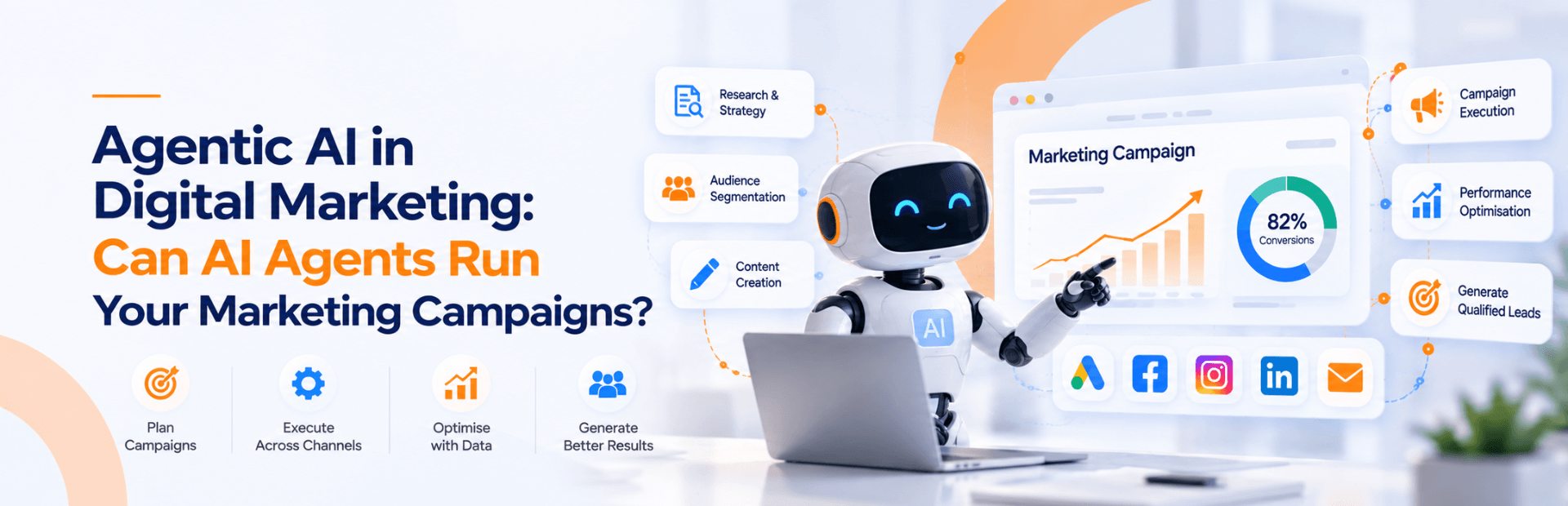
Agentic AI in Digital Marketing: Can AI Agents Run Your Marketing Campaigns?
Explore how AI agents can move beyond content generation to plan, execute and optimise marketing workflows—and why human oversight, clear permissions and measurable goals still matter.
AI has already changed how marketers write copy, generate images, analyse data and brainstorm campaign ideas. But the next stage of artificial intelligence is considerably more ambitious.
Instead of simply answering a prompt, AI agents can be given a marketing goal, decide what steps are required, use connected tools, execute tasks, evaluate the results and determine what to do next.
This is the idea behind agentic AI in digital marketing and the broader shift described in our guide to digital marketing in 2026.
So, could you eventually tell an AI agent, “Generate 500 qualified leads for our new service while keeping cost per lead below ₹2,000,” and allow it to plan and manage much of the campaign?
Increasingly, yes.
But that does not mean marketers should hand over their advertising accounts, customer databases and brand reputation to an unsupervised AI system.
The real opportunity lies somewhere between manual marketing and completely autonomous marketing.
What Is Agentic AI in Digital Marketing?
Agentic AI in digital marketing refers to AI systems that can plan, make decisions and take actions across marketing tools to achieve a defined business objective with limited human intervention.
Traditional AI usually responds to a request.
An AI agent can work towards an outcome.
For example, a generative AI tool may write five Google Ads headlines when asked.
An AI marketing agent could potentially analyse campaign performance, identify an underperforming audience, develop new messaging, generate ad variants, launch an approved experiment, monitor conversions and recommend—or execute—budget changes based on predefined limits.
Google Cloud describes AI agents as systems capable of pursuing goals and completing tasks using reasoning, planning, memory and tools. Modern agents can also coordinate with other agents to handle more complicated workflows.
That difference between generating something and taking action toward an objective is what makes agentic AI important for marketers.
Agentic AI vs Generative AI vs Marketing Automation
These technologies overlap, but they are not the same. To understand how AI is changing discovery and visibility, read our guide to AI search optimization.
| Technology | What It Does | Digital Marketing Example |
|---|---|---|
| Traditional automation | Follows predefined rules | Send an email when someone submits a form |
| Predictive AI | Predicts likely outcomes | Identify customers most likely to convert |
| Generative AI | Creates new content | Write ad copy, emails, blogs or social posts |
| Agentic AI | Reasons, decides and acts | Plan, execute and optimise a multi-channel campaign |
Traditional marketing automation usually requires marketers to design the workflow first.
An AI agent can determine parts of the workflow itself.
You provide the goal, data, tools and boundaries. The agent determines which actions are needed to move towards the goal.
Salesforce similarly distinguishes agentic AI from generative and predictive AI by describing agents as systems that can reason through situations, make decisions and execute marketing actions rather than simply producing content or predictions.
Can AI Agents Really Run Marketing Campaigns?
Yes—but they should currently run campaigns within human-defined goals, permissions and guardrails rather than operate with unlimited autonomy.
An AI marketing agent can already support or execute large parts of the campaign lifecycle, including research, audience creation, campaign planning, content production, personalisation, activation, monitoring, optimisation and reporting.
Major marketing platforms are actively moving in this direction.
Salesforce's current agentic marketing platform allows AI agents to assist with campaign briefs, audiences, customer journeys, content creation and campaign optimisation. Adobe is developing an orchestration layer capable of coordinating AI agents across customer data, content and marketing workflows. HubSpot's Breeze Agents similarly automate marketing, sales and customer-service workflows.
The technology therefore already exists.
The bigger challenge is deciding how much authority the agent should receive.
What Can AI Marketing Agents Actually Do?
1. Marketing Research and Campaign Planning
Before launching a campaign, marketers normally analyse competitors, customer behaviour, search demand, historical campaign results and audience data.
An AI agent can gather this information from connected sources and convert it into an actionable campaign plan.
Instead of simply producing a marketing strategy document, the agent could identify the target audience, recommend channels, estimate resource requirements, create campaign tasks and send them to the relevant systems.
The marketer's role shifts from collecting information manually to reviewing the agent's reasoning and strategic recommendations. Clear, intuitive customer journeys can support these efforts, which is why UI/UX design services are relevant when improving campaign experiences.
2. Audience Segmentation
Customer databases can contain thousands or millions of signals.
AI agents can analyse CRM, CDP, website and behavioural data to identify useful audience segments.
A campaign objective such as:
Increase repeat purchases among customers who purchased during the last six months but have not returned in the past 60 days.
could become an instruction.
The agent could determine the appropriate data conditions, create the segment and prepare a campaign targeting that audience.
Human approval can still be required before activation.
3. Content Creation
Generative AI has already made content creation faster.
Agentic AI adds another layer.
Instead of asking AI separately for an email, landing page, ad and social post, an agent can understand that all of those assets belong to the same campaign.
It can maintain the campaign objective, audience, offer, brand guidelines and messaging across channels.
One campaign brief could therefore generate coordinated search ads, social ads, email sequences, landing-page variants, push notifications and sales-support content. The landing pages and digital experiences behind these campaigns also matter; explore our website development services in Bangalore.
The important difference is orchestration.
4. SEO and Content Marketing
AI agents can also support SEO workflows.
A well-designed SEO agent could analyse existing content, identify topic gaps, compare competing pages, create content briefs, monitor rankings, detect pages losing visibility and recommend updates.
However, publishing hundreds of automatically generated articles simply because an agent can produce them would be the wrong strategy.
Google explicitly states that large-scale AI-generated content created primarily to manipulate rankings can violate its spam policies. Google instead recommends useful, original, people-first content that demonstrates genuine expertise and adds information beyond what already exists online.
Agentic SEO should therefore increase the quality and speed of research and execution—not turn a website into an automated content factory. For practical support with technical SEO, content strategy and organic visibility, explore our SEO services in Bangalore.
5. Paid Media Management
Paid advertising is one of the strongest potential use cases for AI agents because campaigns continuously generate measurable feedback. Businesses looking to connect campaign automation with measurable growth can explore our performance marketing services in Bangalore.
An agent could monitor impressions, clicks, conversion rates, cost per lead, ROAS and other metrics.
If performance moves outside approved thresholds, the agent might adjust bids, shift budgets, pause an underperforming ad or launch a new creative test.
The important phrase is approved thresholds.
A business might allow an AI agent to reallocate 10% of a campaign budget but require human approval for larger changes.
This provides speed without handing unlimited financial authority to the agent.
6. Email and Lead Nurturing
Traditional email automation follows fixed journeys.
Agentic marketing can potentially make those journeys dynamic.
Instead of every prospect receiving the same predetermined sequence, an agent can consider behaviour, interests, lifecycle stage and previous conversations before deciding what message or action should happen next.
A prospect repeatedly visiting a pricing page may receive a different follow-up from someone reading educational articles.
The campaign becomes adaptive rather than purely scheduled. For channel-specific ideas, see our guide to social media marketing in 2026.
7. Campaign Optimisation
Campaign analysis usually happens after marketers collect enough data.
AI agents can make optimisation continuous.
They can watch performance signals, identify anomalies, compare campaign variants and recommend the next action.
Adobe describes agentic workflows as a way of shortening the distance between marketing insight and execution, particularly when customer interests and campaign signals change faster than traditional approval-heavy workflows can respond.
8. Marketing Reporting
Reporting is another strong candidate for agentic automation.
An agent can potentially pull data from analytics platforms, advertising accounts, CRM systems and marketing automation platforms, then produce a single performance summary.
But a sophisticated agent should go further than reporting:
- What happened?
- Why did it happen?
- What should we change next?
The third question is where agentic AI becomes especially valuable.
What Would an Agentic Marketing Campaign Look Like?
Imagine a B2B company launching a new enterprise service.
The marketing team gives its AI agent the following objective:
Generate 300 qualified leads during the next 60 days while maintaining the approved cost-per-qualified-lead target.
The agent analyses previous campaign data, CRM information, customer profiles, competitor positioning and available creative assets.
It proposes target audiences, channels, messaging and budget allocation.
A human marketing lead approves the strategy.
The agent then prepares landing-page variants, paid-search campaigns, LinkedIn ads, nurture emails and supporting content.
After approval, connected systems activate the campaigns.
Once campaigns begin collecting data, the agent monitors results.
If one audience is producing significantly stronger qualified leads, it can recommend moving additional budget towards that audience.
If an ad's conversion rate drops below a defined threshold, it can pause the creative and launch an approved alternative.
The marketing team no longer spends most of its time moving information between tools.
Instead, people manage strategy, creativity, approvals and exceptions while the agent handles much of the execution layer.
That is the practical promise of agentic marketing.
The Four Levels of Marketing Agent Autonomy
Businesses should not think of agentic AI as either “manual” or “fully autonomous.”
A more useful model is an AI Marketing Autonomy Ladder.
| Level | Role of the AI Agent | Human Involvement |
|---|---|---|
| Level 1: Assist | Researches, analyses and creates drafts | Humans execute everything |
| Level 2: Execute | Performs approved actions across tools | Humans approve important actions |
| Level 3: Optimise | Makes limited decisions within predefined thresholds | Humans supervise strategy and exceptions |
| Level 4: Orchestrate | Coordinates multiple agents and channels towards business goals | Humans govern objectives, policies and major decisions |
For most businesses today, Levels 2 and 3 are the sensible target.
They provide meaningful automation while preserving human control over brand, budget, compliance and strategic decisions.
Why Agentic AI Matters for Marketing Teams
Marketing teams are not short of data.
They are often short of the time required to interpret and act on it.
This is where AI agents could create meaningful value.
McKinsey reported in 2026 that around 90% of CMOs were experimenting with AI use cases, yet fewer than 10% had scaled AI or captured value across marketing workflows. The research argues that the biggest opportunity comes not from adding isolated AI tools but from redesigning complete workflows around human-AI collaboration.
Agentic AI can help connect those fragmented activities.
Instead of having one AI tool for content, another dashboard for analytics and another automation platform for customer journeys, agents can potentially coordinate actions across the entire system.
The result is not simply faster content creation.
It is faster movement from data → decision → action → learning.
Will AI Agents Replace Digital Marketers?
Probably not in the way the phrase “replace marketers” suggests.
They are much more likely to replace parts of marketing jobs.
Tasks involving repetitive research, reporting, campaign setup, basic content variations, audience creation and routine optimisation are increasingly suitable for automation.
Activities requiring positioning, cultural understanding, creativity, negotiation, brand judgment, business context and accountability remain much more dependent on people.
The marketer's job therefore changes.
A campaign manager may spend less time manually building campaigns and more time defining objectives, setting guardrails, judging creative work and deciding what the agent should optimise for.
In other words:
AI agents may become the execution layer. Humans remain responsible for direction.
Where AI Agents Still Need Human Oversight
Giving an AI system the ability to take actions introduces risks that do not exist when AI simply generates a paragraph of text.
An incorrect AI-generated headline can be edited.
An autonomous agent with access to an advertising account, CRM or publishing system could potentially make hundreds of incorrect decisions before somebody notices.
Marketing agents therefore need boundaries around spending authority, customer data, publishing access, regulated claims, brand messaging and external communication.
Security also becomes more important because an agent connected to multiple systems may have access to valuable data and actions.
Adobe noted in September 2026 that enterprise IT teams are becoming increasingly cautious precisely because agents can access data, connect systems and act on behalf of users.
Good agentic marketing is therefore not simply about making an AI agent more capable.
It is about making autonomy controlled, observable and reversible.
A Practical Framework for Implementing Agentic AI in Marketing
Step 1: Start With One Business Outcome
Do not begin with:
“We need an AI agent.”
Begin with:
“We spend 25 hours every week monitoring and optimising paid campaigns.”
Or:
“Our lead nurturing process is too slow.”
The business problem should determine whether an agent is necessary.
Step 2: Choose a Repeatable Workflow
Agents work particularly well when a workflow has clear inputs, measurable outputs and repeated actions.
Campaign reporting, lead qualification, customer segmentation, campaign QA and performance monitoring are usually safer starting points than completely autonomous brand strategy.
Step 3: Connect Reliable Data
An intelligent agent running on unreliable data simply makes bad decisions faster.
Customer information, analytics, campaign metrics, product data and brand documentation must be accurate enough for the agent to use.
McKinsey has identified data readiness as one of the major barriers preventing organisations from scaling agentic AI.
Step 4: Define Tools and Permissions
Specify exactly what the agent can access.
Reading Google Analytics may be acceptable.
Changing a campaign budget may require additional permission.
Publishing content may require approval.
Deleting customer records should probably never be an autonomous marketing action.
Step 5: Create Guardrails
Every marketing agent should have clearly defined limits covering budget, compliance, brand voice, customer privacy, approved claims and escalation procedures.
When the agent encounters something outside those limits, it should escalate to a person.
Step 6: Keep Humans in High-Impact Decisions
Not every action needs approval.
That would eliminate much of the benefit of an agent.
Instead, define approval based on risk.
A minor campaign-tagging change might happen automatically.
A ₹10 lakh budget increase should not.
Step 7: Measure Business Outcomes
Do not judge an AI agent by how many tasks it completes.
Measure whether it improves actual marketing performance.
Useful metrics might include cost per acquisition, ROAS, qualified leads, campaign production time, conversion rate, content production cost, response speed and hours saved.
Agentic AI Is Also Changing How Customers Discover Brands
There is another side of agentic marketing that businesses cannot ignore.
Companies will use AI agents to market.
Customers will increasingly use AI agents to research and buy.
Adobe's 2026 research found that 25% of surveyed customers already considered AI platforms such as ChatGPT their top research tool, while many respondents indicated interest in using AI for personalised product discovery.
That changes digital marketing.
Brands will increasingly need to communicate effectively not only with human visitors but also with AI-powered search and recommendation systems that interpret information on the customer's behalf. Learn how to get your brand recommended by ChatGPT, Gemini and Perplexity.
This is where traditional SEO, answer engine optimisation and generative-engine visibility begin to converge. Our guide to GEO vs. SEO vs. AEO explains how these approaches differ and where they overlap.
Your website needs clear information about what your company does, who it serves, how its products or services differ, what they cost where appropriate, and why its claims should be trusted.
More importantly, that information must be genuinely useful.
Google's latest guidance for generative search specifically recommends valuable, original and non-commodity content rather than supposed shortcuts designed purely for AEO or GEO.
So, Can AI Agents Run Your Marketing Campaigns?
Yes. AI agents can already manage significant parts of digital marketing campaigns, and their level of autonomy will continue to increase.
But the winning model is unlikely to be an entirely autonomous marketing department operating without people.
The stronger model is a combination of:
Human strategy + AI execution + human governance.
Humans determine what matters.
AI agents coordinate and execute.
Data provides feedback.
Humans remain accountable for the result.
Businesses that understand this difference will gain more from agentic AI than companies that simply add another AI tool to their marketing stack. If you are planning to apply AI across your marketing workflows, speak with a digital marketing agency in Bangalore or contact the Trivia Digital Agency team.
The question is therefore no longer whether AI agents will become part of digital marketing.
The better question is:
Which parts of your marketing operation are ready to become agentic first?
Frequently Asked Questions About Agentic AI in Digital Marketing
What is agentic AI in digital marketing?
Agentic AI in digital marketing refers to AI systems that can independently plan, make decisions and perform marketing actions to achieve predefined goals. Unlike basic generative AI, an AI agent can use connected tools, evaluate results and determine its next action.
What are AI agents in marketing?
AI agents in marketing are software systems designed to perform or coordinate marketing tasks such as audience segmentation, campaign creation, lead nurturing, content generation, campaign optimisation and reporting.
Can AI agents run digital marketing campaigns automatically?
Yes. AI agents can automate significant parts of campaign planning, activation, monitoring and optimisation when they have access to the necessary data and tools. High-impact actions such as major budget changes, regulated claims or sensitive customer communications should still have appropriate human oversight.
How is agentic AI different from generative AI?
Generative AI primarily creates content in response to prompts. Agentic AI can use AI models, data, memory and external tools to plan and execute a sequence of actions towards a specific objective.
Can AI agents manage Google Ads and paid media?
AI agents can analyse paid-media performance and, when connected to advertising platforms with appropriate permissions, assist with campaign setup, monitoring and optimisation. Businesses should establish strict budget and approval limits before allowing autonomous changes.
Can AI agents help with SEO?
Yes. AI agents can assist with keyword research, competitor analysis, content audits, internal linking, technical monitoring, content briefs and performance analysis. Human expertise remains important for strategy, factual accuracy, original insights and editorial quality.
What is agentic marketing?
Agentic marketing is an approach where autonomous or semi-autonomous AI agents perform and coordinate marketing activities in pursuit of business objectives. Rather than automating one predetermined task, agentic marketing allows AI systems to determine and execute multiple steps in a workflow.
Will AI agents replace marketing agencies or marketing teams?
AI agents are more likely to automate specific marketing tasks than eliminate marketing teams entirely. Strategy, creativity, positioning, stakeholder management, brand judgment and accountability still require strong human involvement.
What is the best marketing task to automate with an AI agent first?
Start with a repeatable, measurable and relatively low-risk workflow such as marketing reporting, campaign monitoring, lead qualification, audience research or content analysis. Expand autonomy only after the system consistently produces reliable results.
What is the future of agentic AI in digital marketing?
Marketing is likely to move towards networks of specialised agents responsible for research, content, media, customer journeys, analytics and optimisation. Human marketers will increasingly define objectives, creative direction and governance while agents coordinate more of the day-to-day execution.
Plan Your Next AI-Powered Marketing Workflow
Connect strategy, SEO, paid media, content and campaign optimisation with a practical digital marketing approach.
Talk to Trivia Digital Agency