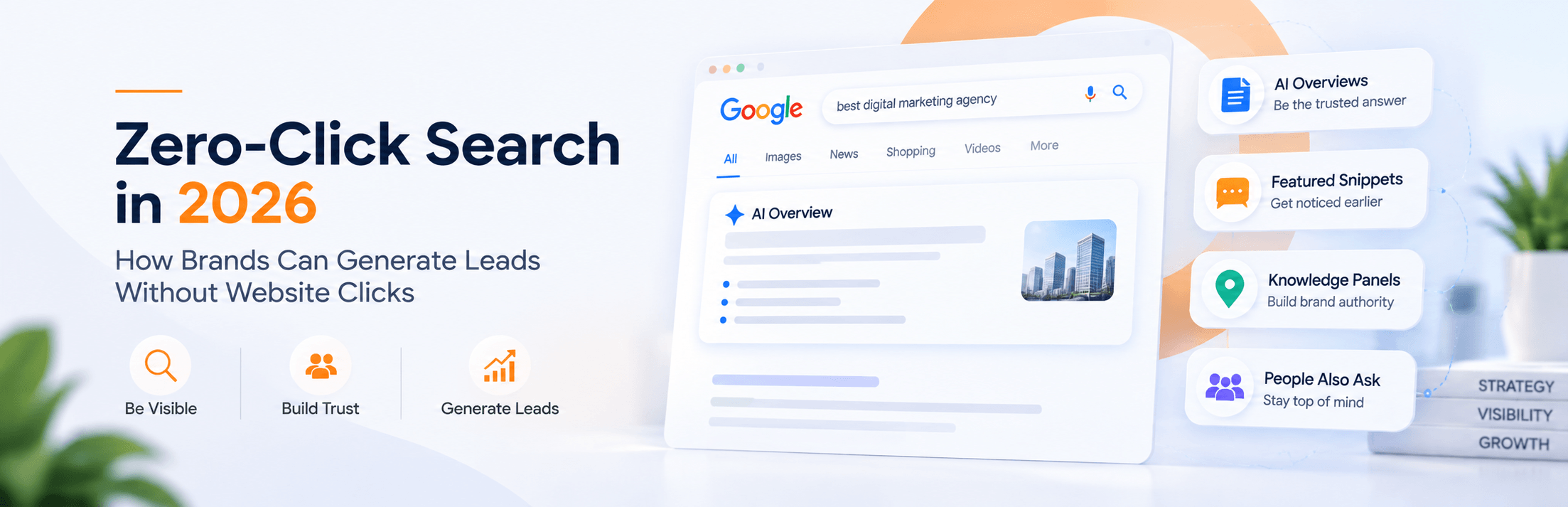
Zero-Click Search in 2026: How Brands Can Generate Leads Without Website Clicks
How brands can generate leads and build visibility when search experiences increasingly answer questions before the click.
For years, digital marketing has followed a simple formula:
In 2026, that journey is changing.
A customer can search for a product, service, company, solution, comparison or recommendation and get enough information directly on the search results page—or inside an AI-powered search experience—to make a decision without visiting a website.
This is the world of zero-click search.
Zero-click search does not necessarily mean zero business value. A customer may see your brand in an AI-generated answer, Google search feature, local result, review platform, video, social post or cited source, remember the brand, and contact the business later through another channel.
Google's current generative AI search guidance confirms that traditional SEO remains important because AI features such as AI Overviews and AI Mode are built on Google's core Search systems. Google also introduced dedicated Search Console reporting for visibility in generative AI features, including AI Overviews and AI Mode, with the reporting rolled out globally by August 31, 2026.
The implication for marketers is significant:
What Is Zero-Click Search?
A zero-click search occurs when a user gets the information they need directly from the search experience without clicking through to an external website.
For example, someone might search:
"What is the best time to post on LinkedIn?"
The search engine may provide the answer directly.
Another person might search:
"SEO agency in Bangalore"
They may see local businesses, reviews, business information and other search features without visiting any agency website.
A third user might ask an AI search engine:
"What should a Bangalore startup look for when choosing an SEO agency?"
The AI system may provide a synthesized answer and mention several agencies or sources.
The user may never click a traditional blue link.
Yet the brands mentioned in that experience have still received digital visibility.
This is why zero-click search should not simply be viewed as a traffic problem.
It is increasingly a visibility, consideration and brand-demand problem.
---
Why Zero-Click Search Matters More in 2026
Search results have evolved from a list of links into increasingly interactive information environments.
Today's search journey can include:
- AI Overviews
- AI Mode
- featured snippets
- local business results
- knowledge panels
- product information
- maps
- images
- videos
- People Also Ask
- reviews
- social content
- forum discussions
- news results
- AI-generated answers
- citations and source links
Google's guidance states that its generative AI search experiences use core Search ranking systems to retrieve relevant web content and ground AI-generated responses.
At the same time, ChatGPT Search provides answers with links to relevant web sources, while websites can make their content eligible for discovery by allowing OAI-SearchBot to crawl their pages.
That creates a new search environment where a brand can be discovered before a user ever reaches its website.
The Old Search Funnel
The traditional model looked like this:
The Emerging Search Funnel
The modern model can look more like:
Sometimes the website visit still happens.
Sometimes it happens later.
Sometimes the customer contacts the company directly.
And sometimes the first measurable interaction occurs somewhere other than the company's website.
---
Zero-Click Does Not Mean Zero Conversion
One of the biggest mistakes marketers can make is assuming:
Consider a local business.
A potential customer searches:
"Best commercial interior design company in Bangalore"
The customer sees:
- the company's name
- reviews
- project images
- location
- service categories
- social media profiles
- third-party mentions
- AI-generated recommendations
The customer doesn't click the company's website.
Later that day, they search the company's name directly.
Then they call.
From a traditional last-click perspective, the lead may appear to have come from:
But the original demand may have been created by search visibility.
This is why marketers increasingly need to distinguish between:
Traffic generation and demand generation.
A zero-click impression can contribute to the second even when it does not produce the first.
---
The Different Types of Zero-Click Search
Zero-click search isn't one single feature.
It is an ecosystem.
1. AI Overviews
Google's AI Overviews can provide synthesized answers directly within Search.
Instead of requiring the user to open multiple websites, the search experience can summarize information and provide supporting links.
For brands, this creates another visibility opportunity:
Google's official guidance says there is no separate special optimization requirement for appearing in its generative AI features. Instead, websites should continue applying foundational SEO practices and create unique, useful, people-first content.
---
2. AI Mode
AI Mode changes the search interaction even further.
Instead of typing a short keyword and browsing results, users can ask more conversational and complex questions.
For example:
"I'm opening a dental clinic in Bangalore. What digital marketing strategy should I use for the first six months?"
An AI search experience may break that request into multiple information needs and synthesize information from different sources.
That means your content may become relevant to a broader question even if the page itself wasn't optimized around the exact wording of the question.
This reinforces the importance of topical authority rather than simply targeting individual keywords.
---
3. Featured Snippets and Direct Answers
Traditional Google results have already supported zero-click behavior for years.
Examples include:
- definitions
- calculations
- dates
- simple factual questions
- how-to information
- quick answers
A page can therefore receive visibility without necessarily receiving a corresponding website visit.
For informational queries, the goal should not always be to hide the answer to force a click.
Instead, provide a useful answer while creating a reason for users to explore your expertise further.
For example:
"Local SEO helps businesses improve visibility in geographically relevant searches."
Then build additional value around:
- implementation
- examples
- mistakes
- benchmarks
- strategy
- tools
- case studies
- expert insights
The direct answer establishes visibility.
The deeper content establishes authority.
---
4. Local Search
Local search is one of the most important zero-click environments for businesses.
A customer searching:
"Digital marketing agency near me"
may see local business information before visiting a website.
The decision can be influenced by:
- business name
- reviews
- rating
- location
- service categories
- photos
- opening hours
- phone number
- posts
- website information
- third-party mentions
For local businesses, Google Business Profile optimization is therefore part of search marketing—not merely a directory task.
Your website is only one component of your local search presence.
---
5. Social and Video Search
Search visibility is also expanding beyond websites.
Google introduced platform properties in Search Console in 2026 to help creators and site owners understand how content on platforms such as Instagram, TikTok, X and YouTube performs in Google Search and Discover.
This is an important development.
A customer might discover your brand through:
- YouTube
- TikTok
- X
- podcasts
- industry publications
and never visit your website during the initial discovery stage.
The brand can still enter the customer's consideration set.
---
6. AI Search Citations
AI search creates another form of zero-click visibility:
AI-powered search systems can reference websites as sources when generating answers.
ChatGPT Search, for example, can include citations and source links in search responses. OpenAI also states that public websites can appear in ChatGPT Search and recommends allowing OAI-SearchBot when publishers want their content to be discoverable, surfaced and clearly cited.
This creates a new question for marketers:
"Is my brand being cited when customers ask questions related to my industry?"
That question is different from:
"What position does my website rank for?"
Both matter.
---
How Brands Can Generate Leads Without Website Clicks
The objective isn't to stop people from visiting your website.
The objective is to make your brand valuable even before the click.
Here are the major strategies.
1. Build Brand Recognition Across Search
If someone repeatedly encounters your brand across different search experiences, recognition increases.
Build consistent visibility across:
- Google Search
- Google Business Profile
- industry directories
- YouTube
- review platforms
- PR publications
- expert interviews
- podcasts
- communities
- third-party websites
The more consistent your entity information becomes, the easier it is for customers—and search systems—to understand what your company does.
---
2. Create Content That Answers Real Questions
Zero-click search favors content that can provide clear answers.
Instead of publishing only:
"10 Reasons You Need SEO"
create content around real customer questions:
- How much does SEO cost?
- How long does SEO take?
- Should a startup invest in SEO?
- SEO vs Google Ads: which should businesses use?
- How can a local business generate leads from Google?
- How does AI search affect SEO?
- How can a company appear in AI-generated answers?
These questions align more naturally with conversational search.
They also give AI systems clearer information to retrieve and synthesize.
---
3. Structure Content for Direct Answers
Make important information easy to understand.
A strong page structure can include:
Question
What is zero-click search?
Direct answer
Zero-click search occurs when users obtain the information they need directly within a search experience without visiting an external website.
Explanation
Expand on the concept.
Examples
Show practical scenarios.
Evidence
Include original data, examples, sources or expert commentary.
Action
Tell the reader what they should do.
This structure helps humans scan content and makes important concepts easier for search systems to interpret.
---
4. Develop Topical Authority
One article rarely establishes authority.
A stronger approach is to create a connected content ecosystem.
For a digital marketing agency, for example, a topical cluster could include:
- SEO strategy
- technical SEO
- local SEO
- enterprise SEO
- e-commerce SEO
- AI SEO
- GEO
- AEO
- AI citations
- AI Overviews
- AI search optimization
- zero-click search
- Google Ads
- Meta Ads
- conversion optimization
- landing pages
- lead generation
- content strategy
- thought leadership
- content marketing
- original research
This gives search engines and AI systems more context about the company's expertise.
---
5. Publish Original Information
Generic content is increasingly easy to reproduce.
AI systems can generate summaries of information that already exists.
That makes original information more valuable.
Consider creating:
- original research
- customer surveys
- industry reports
- case studies
- experiments
- benchmark studies
- proprietary frameworks
- expert interviews
- first-hand observations
- original statistics
For example, instead of publishing:
"SEO is important for businesses."
publish:
"We analyzed 100 local service websites and identified five recurring technical SEO problems."
The second idea provides something more distinctive.
Google specifically recommends creating unique, valuable, non-commodity content rather than relying on tactics designed as artificial "AI optimization" hacks.
---
6. Turn Your Experts Into Search Assets
People increasingly search for expertise, not just companies.
That means your organization's experts should have visible digital identities.
Create:
- author profiles
- expert bios
- LinkedIn profiles
- interviews
- conference appearances
- webinars
- podcasts
- expert quotes
- industry contributions
An expert's knowledge should not exist only inside the company.
It should become part of the public information ecosystem.
---
7. Strengthen Your Brand Entity
Search visibility is increasingly about entities and relationships.
Your company should be clearly associated with:
- what you do
- where you operate
- who you serve
- industries you specialize in
- services you provide
- people behind the company
- products you offer
- expertise you demonstrate
For example:
The stronger these relationships become across trusted sources, the easier it is for search systems to understand the business.
---
8. Optimize Your Google Business Profile
For local businesses, this should be a core part of zero-click strategy.
Keep information accurate and complete.
Focus on:
- correct business category
- services
- description
- location
- phone number
- website
- photos
- business hours
- reviews
- responses to reviews
- relevant updates
Most importantly, keep the information consistent with your website and other authoritative business profiles.
---
9. Earn Authentic Third-Party Mentions
Brand visibility doesn't have to come from your own website.
Work toward legitimate mentions through:
- industry publications
- professional organizations
- interviews
- podcasts
- conferences
- partnerships
- expert contributions
- local publications
- case studies
- reputable directories
The goal isn't to manufacture mentions.
It is to create genuine evidence that your company exists, operates in a particular field and has relevant expertise.
Google explicitly cautions against pursuing inauthentic mentions as an AI-search optimization tactic.
---
10. Make Your Brand Easy to Contact
If zero-click visibility generates demand, the next question is:
Don't make customers search for your contact information.
Make important actions easy to discover:
- Call
- Book a consultation
- Request a quote
- Get directions
- Send an email
- Schedule a demo
- Download a guide
For local businesses especially, a phone call may be more valuable than a website session.
---
Zero-Click SEO vs Traditional SEO
Zero-click SEO does not replace traditional SEO.
It expands the definition of SEO.
| Traditional SEOZero-Click / AI Search | |
|---|---|
| Rankings | Visibility |
| Website traffic | Brand exposure |
| Click-through rate | Mentions and citations |
| Keywords | Questions and topics |
| Backlinks | Authority signals |
| Landing pages | Information ecosystem |
| Organic sessions | Brand demand |
| Conversion tracking | Multi-touch attribution |
The two approaches should work together.
A business still needs technically sound pages, crawlability, useful content, strong information architecture and relevant authority.
Google's current documentation explicitly states that foundational SEO remains relevant for its generative AI search features.
---
How to Measure Zero-Click Search Success
This is where many businesses need to change their reporting.
If you only measure:
you may underestimate search's contribution.
Instead, create a broader visibility dashboard.
1. Search Visibility
Track:
- impressions
- rankings
- branded searches
- non-branded searches
- SERP features
- local visibility
2. AI Visibility
Track:
- AI Overview appearances
- AI Mode visibility
- AI citations
- brand mentions
- cited URLs
- AI-generated recommendations
- visibility across major AI search platforms
Google's Generative AI performance reporting in Search Console provides dedicated visibility data for generative AI features, including impressions and pages appearing in those experiences.
---
3. Brand Search Growth
Watch for changes in:
- branded search volume
- direct traffic
- branded clicks
- brand + service searches
- brand + location searches
If users discover your company through search but return later by searching the brand name, traditional last-click attribution may miss part of the original discovery journey.
---
4. Assisted Conversions
Analyze whether organic search or AI visibility appears earlier in the customer's journey.
For example:
The final conversion may be attributed to the branded search, but the original discovery happened earlier.
---
5. Phone and Offline Leads
For local and service businesses, track:
- phone calls
- WhatsApp enquiries
- direction requests
- booked appointments
- quote requests
- store visits
- sales conversations
The goal is not simply to increase sessions.
The goal is to increase qualified demand.
---
How to Build a Zero-Click Search Strategy
A practical strategy can be organized into five stages.
Stage 1: Identify Customer Questions
Research:
- Google queries
- People Also Ask
- related searches
- Reddit discussions
- forums
- customer-support questions
- sales questions
- AI search prompts
Build a list of the questions customers actually ask.
---
Stage 2: Map Questions to Search Experiences
Classify each question.
| Query TypePotential Search Experience | |
|---|---|
| Definition | Direct answer |
| Local service | Local results |
| Comparison | AI/search results |
| Product | Shopping/search |
| How-to | Featured/AI answer |
| Complex research | AI search |
| Brand query | Knowledge/search results |
| Visual query | Images/video |
| Expert query | Publications/social/AI |
This helps determine what type of visibility you need.
---
Stage 3: Create the Source Material
Build:
- service pages
- comparison pages
- FAQs
- guides
- case studies
- research
- videos
- social content
- expert commentary
- local content
Your website should remain the source of truth, while other platforms extend your reach.
---
Stage 4: Build External Authority
Promote expertise through:
- PR
- partnerships
- interviews
- podcasts
- industry websites
- professional communities
- social platforms
- video
- genuine reviews
This creates a broader information footprint.
---
Stage 5: Measure Visibility and Business Impact
Review monthly:
→ rankings
→ impressions
→ SERP features
→ AI visibility
→ citations
→ mentions
→ branded searches
→ direct traffic
→ social discovery
→ calls
→ enquiries
→ demos
→ consultations
→ revenue
This creates a much more realistic picture of modern search performance.
---
Zero-Click Search and E-E-A-T
Zero-click search makes trust even more important.
When users don't immediately visit your website, they may judge your brand based on what they see elsewhere.
That makes Experience, Expertise, Authoritativeness and Trustworthiness important across your entire digital ecosystem.
Demonstrate:
Experience
Show what your team has actually done.
Expertise
Publish expert-level insights.
Authority
Earn recognition from relevant sources.
Trust
Maintain accurate, transparent and consistent information.
A company should not only say:
"We are experts."
It should demonstrate expertise through evidence.
---
Do You Need Special "AI SEO" Tricks?
Be careful with promises such as:
- guaranteed ChatGPT rankings
- guaranteed AI citations
- secret AI ranking formulas
- special AI-only schema
- guaranteed Google AI Overview placement
- guaranteed LLM rankings
Search and AI systems continuously evolve.
Google's official guidance specifically recommends focusing on foundational SEO and useful, unique content rather than artificial optimization hacks. It also says site owners should be cautious about third-party tools claiming access to Google's internal ranking or AI systems.
The more sustainable approach is:
---
Is Zero-Click Search Bad for SEO?
Not necessarily.
It changes what SEO is expected to accomplish.
If a page receives an impression, helps answer a question, increases brand recognition and eventually contributes to a lead, its value may extend beyond the immediate click.
The bigger problem is measuring search with an outdated model.
If the only KPI is:
then zero-click visibility can look like a failure.
If the KPI becomes:
the picture becomes broader.
---
The Future of SEO Is Search Visibility
SEO is moving from a website-only discipline toward a broader digital visibility discipline.
Brands now need to think about:
-
-
-
-
-
-
-
-
-
The website remains important.
But it is no longer the only place where the customer experiences your brand.
Your brand can be discovered before the click.
Your expertise can be demonstrated before the click.
Your reputation can be evaluated before the click.
Your brand can be recommended before the click.
And in some cases, the customer can become a lead without ever visiting your website.
---
Final Takeaway
In 2026, brands should stop measuring search success only through website sessions.
Instead, build a strategy around four objectives:
- Be discoverable
- Be understandable
- Be trusted
- Be chosen
Create useful content.
Build genuine expertise.
Strengthen your brand entity.
Optimize local and third-party visibility.
Make your content accessible to search systems.
Earn authentic mentions.
Monitor AI search visibility.
And connect visibility metrics with actual business outcomes.
The winning question in modern search is no longer simply:
"How do we get the user to click?"
It is:
"How do we become the brand the user remembers, trusts and chooses—even when the search experience doesn't require a click?"
That is the real opportunity behind zero-click search in 2026.
Frequently Asked Questions
What is zero-click search?
Zero-click search occurs when a user gets the information they need directly within a search experience without clicking through to an external website. Examples include AI-generated answers, local results, featured snippets and other direct-answer search features.
Is zero-click search replacing SEO?
No. Zero-click search is changing how SEO success is measured, but foundational SEO remains important. Google's own guidance says its generative AI search features are built on core Search ranking and quality systems.
Can zero-click searches generate leads?
Yes. A zero-click interaction can increase brand awareness, trust and consideration. A customer may later call, search for the brand, visit a physical location, send a message or make a purchase without the original search producing a website click.
How can my brand appear in AI search?
Start with foundational SEO, useful and original content, strong technical accessibility, clear business information, topical authority and genuine third-party recognition. Google does not recommend special AI-search hacks as a substitute for these fundamentals.
How do I measure zero-click SEO?
Measure more than organic clicks. Track impressions, SERP features, local visibility, branded searches, AI visibility, AI citations, brand mentions, direct traffic, calls, enquiries and conversions.
Can websites appear in ChatGPT Search?
Yes. OpenAI states that public websites can appear in ChatGPT Search. Websites that want their content to be discoverable and potentially cited should allow OAI-SearchBot to crawl relevant content. Placement is not guaranteed.
Does zero-click search mean website traffic is no longer important?
No. Website traffic remains valuable for many businesses because the website provides detailed information, conversion opportunities and first-party analytics. The change is that website traffic is now one part of a broader search visibility strategy.
What should businesses focus on for zero-click search in 2026?
Focus on strong technical SEO, useful original content, topical authority, local search, brand/entity consistency, authentic third-party mentions, expert content, AI-search visibility and measurement tied to business outcomes.
SEO/GEO/AEO Optimization Checklist
Technical SEO
- Crawlable pages
- Indexable content
- Strong internal linking
- Clear information architecture
- Mobile-friendly experience
- Fast performance
- Appropriate structured data
- Accurate canonicalization
SEO
- Search-intent-focused content
- Topic clusters
- Strong service pages
- Original research
- Internal links
- Relevant external references
- Updated content
GEO
- Clear entities
- First-hand expertise
- Direct answers
- Context-rich content
- Author information
- Brand consistency
- Authentic third-party mentions
AEO
- Question-based headings
- Concise answers
- Definitions
- Comparison tables
- Step-by-step explanations
- FAQs
- Natural conversational language
AI Search
- Monitor AI visibility
- Track citations
- Make important information easy to retrieve
- Build authoritative source content
- Allow relevant search crawlers
- Avoid artificial AI-visibility tactics
Business
- Track calls
- Track enquiries
- Track branded searches
- Track assisted conversions
- Track qualified leads
- Connect search visibility to revenue
The objective is not simply to generate more clicks.
The objective is to make your brand visible and valuable throughout the entire modern search journey.
Make Your Brand Visible Beyond the Click
The objective is not simply to generate more clicks.
The objective is to make your brand visible and valuable throughout the entire modern search journey.